ClearScore South Africa: How It Works & How to Check Your Score
November 05, 2026
What You Need to Know Before Using ClearScore
Last updated: November 2026
Want to check your credit score without paying a fee or affecting your credit record? ClearScore is one way to do it.
ClearScore is a free online service that lets South Africans view their Experian credit score and credit report. You can use it to check your borrowing history, spot possible mistakes and see how your credit profile changes over time.
But what does your ClearScore number mean? Is it the same score your bank uses? And can ClearScore actually help you improve your credit?
This guide explains how ClearScore works in South Africa, how to use it and what to do when something on your report does not look right.
Quick answer: ClearScore gives you free access to your Experian credit information. Checking your own score does not lower it, and you do not need to apply for a loan or credit card to use the service.
What Is ClearScore South Africa?
ClearScore is a financial information service that helps people understand their credit records.
It is not a bank, a lender or a credit bureau. Instead, ClearScore works with Experian, a registered credit bureau in South Africa.
Experian collects information about how people use and repay credit. ClearScore displays this information in a format that is easier to read.
With a free ClearScore account, you can:
- View your Experian credit score.
- Read your credit report.
- Check reported loans, credit cards and other credit accounts.
- See factors that may be affecting your score.
- Track changes in your credit information over time.
- Find possible mistakes that need correcting.
- View personalised financial product offers, if you choose.
You can access ClearScore through its South African website or mobile app.
Official website: www.clearscore.com/za
Is ClearScore Really Free in South Africa?
Yes. ClearScore provides free access to your Experian credit score and credit report.
There is no subscription fee for the standard service, no free trial that later becomes a paid subscription and no requirement to provide a credit card to check your score.
So how does ClearScore make money?
ClearScore also displays financial products, including loans and credit cards, from participating providers.
If someone applies for a financial product through ClearScore and is approved, ClearScore may earn a commission from the provider.
This means you can use ClearScore without paying for your report. You are also free to ignore the offers and simply monitor your credit information.
Important: A free credit score does not mean a loan offered through ClearScore is free. Any loan will have its own interest rates, fees and repayment conditions.
How to Check Your Credit Score on ClearScore
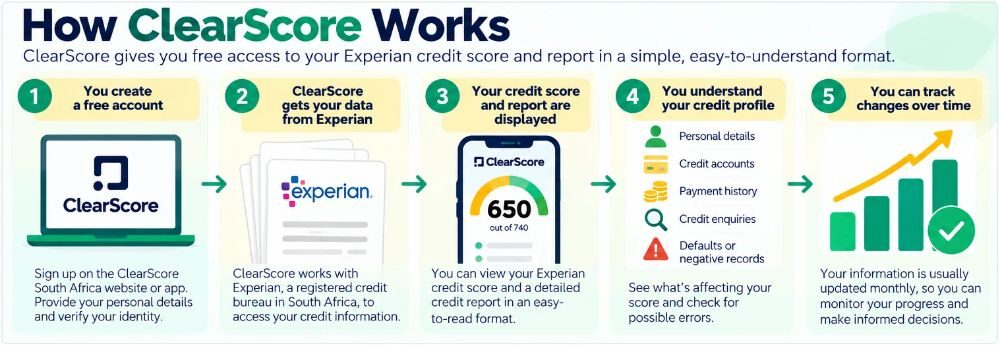
Getting started is straightforward. ClearScore says registration usually takes only a few minutes, although identity checks may take longer for some users.
Step 1: Visit the Official ClearScore Website
Go to ClearScore South Africa or download the official ClearScore app for Android or iPhone.
Make sure you are using the South African service rather than the UK version.
Step 2: Create Your Account
Select the registration option and enter the personal details requested.
Use accurate information that matches your official identity records. Incorrect details can make it harder for ClearScore to locate your credit report.
Step 3: Verify Your Identity
ClearScore must confirm that you are the person entitled to view the credit information.
You may need to complete identity checks or provide additional information. Follow the instructions shown during registration.
These checks help protect your personal financial information.
Step 4: View Your Credit Score and Report
Once your account is ready, you can see the Experian credit information available for you.
Start by checking your score, then open your credit report to review the accounts and payment information behind it.
Do not focus only on the number. The information in the report is often more useful.
Step 5: Check Your Report Regularly
ClearScore normally refreshes your Experian information about once a month.
Checking regularly can help you spot changes, track repayments and identify possible errors before you apply for credit.
How Does the ClearScore Credit Score Work?
ClearScore displays a credit score based on information held by Experian South Africa.
Experian uses a scoring model to estimate how likely someone is to repay borrowed money.
The score is based on information such as:
- Whether you repay credit accounts on time.
- How much money you already owe.
- How much of your available credit you use.
- How long you have managed credit accounts.
- Recent credit applications and enquiries.
- Other information recorded in your credit history.
ClearScore currently describes its South African Experian score as ranging from 0 to 740.
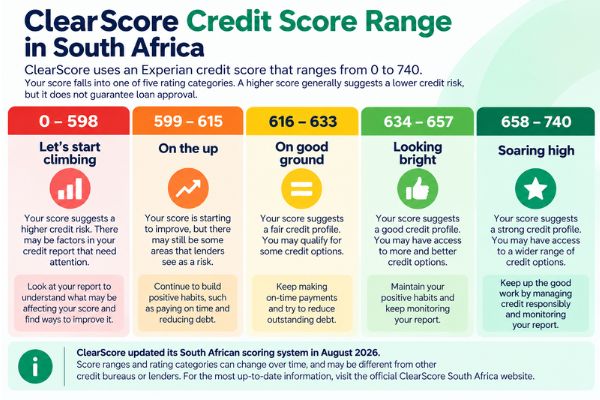
Generally, a higher score suggests a stronger credit profile. However, it does not guarantee loan approval.
For a detailed explanation of credit scores, read our guide to what your credit score means in South Africa.
What Changed With ClearScore’s Scoring System in 2026?
ClearScore announced an updated scoring system in August 2026.
This matters because older articles, screenshots and score comparisons may use different rating categories or scoring methods.
If your score changed after an update, it does not automatically mean your borrowing habits became better or worse.
A change in the scoring method can also affect the number displayed.
What should you do? Use the current score and explanations in your ClearScore account. When comparing your progress, also look at your payment history, outstanding debt and other information in the report.
What Can You See on Your ClearScore Credit Report?
Your credit score is only a summary. Your credit report provides the details behind it.
Here are the main things worth checking.
| Report Information | What to Look For |
|---|---|
| Personal details | Check that your name and other identifying information are correct. |
| Credit accounts | Look for loans, credit cards and accounts you recognise. |
| Outstanding balances | Check whether the reported amounts appear correct. |
| Payment history | Look for missed or late payments and check whether they are accurate. |
| Credit enquiries | Review recorded credit applications or checks you do not recognise. |
| Defaults or other negative records | Check the details and whether the information is accurate and up to date. |
Example: You finished paying a clothing account two months ago, but your report still shows a balance.
First, check the date of the report and allow for normal reporting delays. If the information remains incorrect, contact the credit provider or raise a dispute with Experian.
You should also investigate any account you do not recognise, as it could be an error or a sign that someone has used your details without permission.
Does Checking ClearScore Affect Your Credit Score?
No. Checking your own credit score through ClearScore does not lower your score.
This is known as a soft enquiry.
A soft enquiry allows you to view your own credit information without creating the same type of credit application enquiry that lenders may record when assessing a loan.
However, there is an important difference between checking your score and applying for credit.
| Action | Can It Affect Your Score? |
|---|---|
| Logging into ClearScore | No. |
| Viewing your credit report | No. |
| Checking personalised offers using a soft eligibility search | No, where the check is explicitly a soft enquiry. |
| Submitting a formal loan or credit card application | It may. A lender may carry out a hard credit enquiry. |
You can therefore monitor your credit through ClearScore without worrying that each login will damage your score.
Before applying for a financial product, check whether the next step involves a full credit application.
Why Is My ClearScore Different From My Bank’s Credit Score?
Your ClearScore number may be different from the score shown by your bank or another credit service.
That does not necessarily mean either score is wrong.
ClearScore displays information from Experian. Other lenders and financial services may use TransUnion, XDS or another scoring model.
Different credit bureaus may hold different information because credit providers do not always report to every bureau at the same time.
For example, a bank may use its own lending score alongside information from a credit bureau.
Remember: A score of 650 from one scoring model cannot automatically be compared with 650 from another.
Read our guide to credit bureaus in South Africa to understand how the different services work.
Why Has My ClearScore Not Updated?
One of the most common frustrations is paying off debt and then seeing the old balance or the same score on ClearScore.
There are several possible reasons.
1. Your Lender Has Not Reported the Change Yet
Credit providers usually send updates to credit bureaus on a reporting schedule.
A payment made today may not appear immediately.
2. ClearScore Has Not Refreshed Your Report Yet
ClearScore generally updates Experian information monthly.
If your lender sends new information after the latest update, you may need to wait until the next refresh.
3. Your Report Changed but Your Score Did Not
Not every payment or account update changes your score.
For example, paying one instalment on time is positive, but the scoring model may not change your number that month.
4. There May Be an Error
If an account continues to show incorrect information after a reasonable reporting period, investigate it.
ClearScore advises that some changes may take around four to six weeks to appear.
What to do: Check the report date, compare the balance with your latest statement and contact the credit provider if necessary. If the information remains incorrect, raise a dispute.
What if ClearScore Shows No Credit Score?
Some people see no numerical score or a result such as -1.
This does not automatically mean you have bad credit.
It may mean Experian does not have enough information to calculate a score.
This can happen if you:
- Have never had a credit account.
- Have very little reported borrowing history.
- Are new to the South African credit system.
- Have an identity or credit-file matching problem.
Example: You have a salary, a savings account and no debt. You may manage your money well but still have little credit history for a bureau to score.
Do not take out an expensive loan simply to create a credit score.
If you want to establish a credit record, start by understanding how credit reporting works and only consider an affordable credit product if you genuinely need it.
Our step-by-step guide to building credit in South Africa explains the options.
How to Fix Incorrect Information on ClearScore
Finding a mistake on your credit report can be worrying, especially if you are planning to apply for a loan, vehicle finance or a home loan.
The important thing to know is that ClearScore cannot directly change your Experian credit records.
Experian is the credit bureau responsible for the underlying information.
Step 1: Identify the Mistake
Check exactly what appears incorrect.
Examples include:
- An account you never opened.
- A payment marked late even though you paid on time.
- An incorrect outstanding balance.
- A settled account still showing an incorrect status.
- Incorrect personal information.
- A credit enquiry you do not recognise.
Step 2: Gather Supporting Documents
Keep relevant bank statements, payment receipts, settlement letters or account statements.
These documents may help show why the information should be corrected.
Step 3: Raise a Dispute With Experian
You can raise a dispute through ClearScore’s official dispute process or contact Experian directly.
Explain which information is incorrect and provide any supporting documents requested. If you submit the dispute through ClearScore, use the email address linked to your ClearScore account and provide the identification details requested.
Experian generally has up to 20 business days to investigate a formal dispute. Keep your reference number and check your email, including your spam folder, for updates.
Step 4: Check the Outcome
Keep the dispute reference number and any written response.
Important: While a formal dispute is being investigated, your credit file may show a dispute status. This could affect a new credit application, so consider resolving the issue before applying where possible.
After the matter is resolved, check your updated report to see whether the correction appears.
If you disagree with the outcome, you can ask about further complaint or escalation options through the National Credit Regulator or the appropriate credit dispute body.
Important: You can challenge information that is incorrect, incomplete or unlawfully recorded. You cannot simply demand the removal of accurate negative information because it affects your score.
Can ClearScore Help You Improve Your Credit Score?
ClearScore cannot directly increase your credit score.
However, it can help you understand what needs attention.
For example, your report may show that you have missed repayments, high credit card balances or several recent credit applications.
Once you understand the problem, you can take practical steps.
- Pay on time: Make at least the required payment by the due date.
- Reduce expensive debt: Where possible, pay down outstanding balances without missing essential living costs.
- Avoid unnecessary applications: Do not apply for several loans simply to see who approves you.
- Correct errors: Dispute inaccurate information through the relevant credit bureau.
- Monitor progress: Check your report over several months rather than expecting an immediate improvement.
Improving your score usually takes time. No service can guarantee a specific score increase.
For more detailed advice, read our guide to improving your credit score in South Africa.
Does ClearScore Offer Loans in South Africa?
ClearScore is not a direct lender, but it displays loans and other financial products from participating providers.
Some offers may be personalised using information from your credit profile.
ClearScore may also show whether you appear likely to qualify for certain products.
However, a personalised offer or pre-approval indication does not guarantee that the lender will approve your application.
The lender may still check your income, expenses, credit history and affordability.
Before applying: Compare the interest rate, initiation fee, monthly service fees, repayment period and total amount repayable.
You can also compare loan options in South Africa to understand the different borrowing structures available.
Is ClearScore Safe to Use?
ClearScore is an established service that works with Experian to provide access to credit information.
It publishes terms, privacy information and details of how personal information is used.
However, any service handling financial information requires care.
To protect yourself:
- Use the official South African ClearScore website or app.
- Never share your password or one-time PIN with someone claiming to help you improve your score.
- Be cautious of messages promising guaranteed loan approval.
- Read the privacy policy before registering.
- Check your account and credit report for unfamiliar activity.
- Contact the official support service if you suspect unauthorised access.
ClearScore may use your credit information to personalise financial offers. You should understand this before signing up.
You can also review your privacy and marketing preferences in your ClearScore account settings, including options to limit certain advertising-related data sharing.
Read the ClearScore privacy policy for details.
What to Do After Checking Your ClearScore
You do not need to spend hours studying your report.
A simple monthly check can help you stay informed.
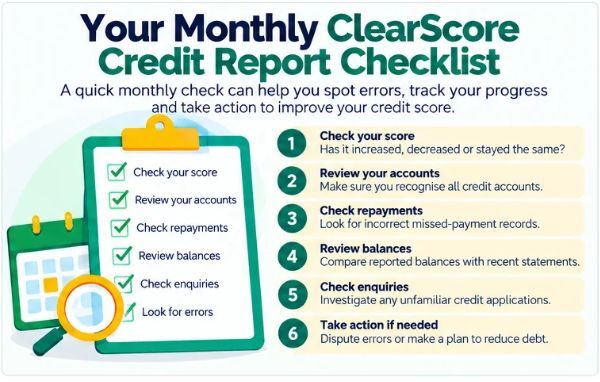
| Monthly Check | What to Do |
|---|---|
| 1. Check your score | Note whether it has increased, decreased or stayed the same. |
| 2. Review your accounts | Make sure you recognise the credit accounts shown. |
| 3. Check repayments | Look for incorrect missed-payment records. |
| 4. Review balances | Compare reported balances with recent statements. |
| 5. Check enquiries | Investigate unfamiliar credit applications or searches. |
| 6. Choose one action | For example, correct an error or make a plan to reduce debt. |
Our recommendation: Spend five minutes reviewing your ClearScore each month. Focus on the accuracy of your report and your repayment habits, not just whether your score increased.
ClearScore South Africa: Pros and Limitations
| Advantages | Limitations |
|---|---|
| Free access to your Experian credit score and report | Does not show every credit bureau’s report |
| Checking your own score does not lower it | Your bank may use a different scoring model |
| Helps you monitor credit accounts and changes | Some account updates take weeks to appear |
| Provides explanations of credit factors | Cannot directly change incorrect bureau records |
| Can help you identify possible errors | Cannot guarantee a better score or loan approval |
| Available online and through a mobile app | Displays financial product offers that may not suit everyone |
Frequently Asked Questions About ClearScore South Africa
Is ClearScore free in South Africa?
Yes. ClearScore provides free access to your Experian credit score and report. You do not need to pay a subscription fee or apply for a financial product to use the standard service.
Does ClearScore affect my credit score?
No. Checking your own score or report through ClearScore is a soft enquiry and does not lower your credit score. A formal credit application may involve a different type of enquiry.
Which credit bureau does ClearScore use in South Africa?
ClearScore uses information from Experian South Africa. It does not automatically show your complete records from every other credit bureau.
What is a good ClearScore credit score in South Africa?
ClearScore currently uses an Experian score range of 0 to 740. Higher scores generally suggest lower credit risk, but rating bands and scoring methods can change. No score guarantees loan approval.
How often does ClearScore update?
ClearScore generally updates your Experian credit information about once a month. Changes from lenders may take several weeks to appear, depending on when they report information.
Why is my ClearScore different from my bank’s score?
Your bank may use another credit bureau or its own scoring model. Different models and reporting dates can produce different scores, even for the same person.
Why does ClearScore show -1 or no credit score?
This can mean there is not enough credit information. It does not automatically mean you have bad credit. Identity matching problems may also need investigation.
Can I dispute an error on ClearScore?
Yes. You can raise a dispute with Experian, either through ClearScore’s guidance or directly with the bureau. ClearScore cannot change Experian’s records itself.
Can ClearScore improve my credit score?
ClearScore cannot directly improve your score. It helps you understand your credit information so you can take steps such as paying on time, reducing debt and correcting errors.
Does ClearScore guarantee loan approval?
No. ClearScore may display personalised offers or pre-approval indications, but the lender makes the final decision after its own credit and affordability checks.
Final Verdict: Is ClearScore Worth Using in South Africa?
ClearScore is a useful free tool for South Africans who want to understand and monitor their credit information.
Its main benefit is easy access to your Experian credit score and report without paying a fee or affecting your score when you check it.
However, it is important to remember that ClearScore shows information from one credit bureau. Your bank may use a different score, and updates may not appear immediately.
Our recommendation: Use ClearScore to check your credit report regularly, investigate mistakes and track your financial progress. Treat your credit score as a guide rather than a guarantee of whether you will qualify for a loan.
If your goal is to improve your borrowing options, start by understanding your credit report and building a reliable repayment history.
Sources and References
- ClearScore South Africa – Official Website
- ClearScore – Free Credit Score and Report
- ClearScore – Experian Credit Score and Report Explained
- ClearScore – New Credit Scoring System
- ClearScore – Why Your Credit Score Has Not Changed
- ClearScore – How Credit Report Information Is Obtained
- ClearScore – Privacy Policy
- National Credit Regulator – South Africa
Sources reviewed: October 2026. ClearScore’s features, scoring system and product offers may change. Check the official South African website for current information.
Editorial disclosure: This independent educational guide was prepared by FatCat Loans using publicly available information. FatCat Loans is not ClearScore or Experian and is not responsible for their credit records, scoring methods or services. Mentioning ClearScore does not imply a commercial partnership or endorsement.

The FatCat Loans Editorial Team delivers clear, accurate, and unbiased guidance on loans, credit, and personal finance in South Africa, in compliance with the National Credit Act. Our writers follow strict editorial standards to ensure every article is trustworthy, well-researched, and easy to understand, helping readers make confident financial decisions.