Capfin Loans Review: Rates, Fees, Eligibility, Risks & Analysis
February 28, 2026
Capfin Personal Loan Review
Last Updated: September 2026
Reviewed by: FatCat Loans South Africa Editorial Team
Regulatory Status: Capfin is registered with the National Credit Regulator (NCRCP13053).
This guide is informational only and does not constitute financial advice. Always review your full pre-agreement statement and credit agreement before accepting any loan.
How We Evaluate Personal Loan Providers
Our reviews are based on publicly available information, regulatory disclosures, and standardised comparison criteria.
When assessing lenders like Capfin, we evaluate:
- Regulatory registration and compliance under the National Credit Act
- Transparency of fees and total cost disclosure
- Loan structure and repayment flexibility
- Credit impact and affordability safeguards
- Suitability for different borrower profiles
We do not rank lenders based on approval speed alone.
Our focus is long-term affordability, sustainability, and regulatory compliance.
Executive Summary
Capfin is one of South Africa’s most recognised unsecured personal loan providers.
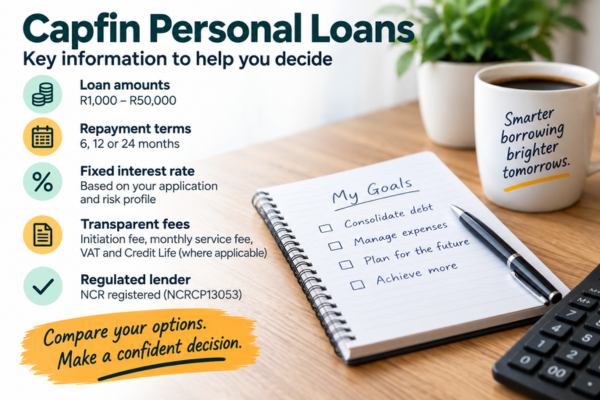
Capfin currently offers personal loans from R1,000 up to R50,000, with repayment terms of 6, 12 or 24 months, subject to its credit application and affordability assessment.
Unlike payday lenders that require lump-sum repayment within 30–49 days, Capfin provides structured monthly instalment loans.
That structural difference reduces immediate repayment pressure but increases total interest exposure over time.
Capfin may suit borrowers who:
- Need more than R8,000
- Prefer predictable monthly repayments
- Have stable employment income
- Want structured medium-term credit
However, total cost includes:
- Risk-based interest
- Initiation fee
- Monthly service fee
- VAT on applicable fees
- Capfin Credit Life, where applicable
If you are evaluating structured unsecured credit, you can compare regulated options in our personal loans hub.
Who Is Capfin?
Capfin is a division of Pepkor Trading (Pty) Ltd and operates as a registered credit provider under South Africa’s National Credit Act (NCA), with NCR registration NCRCP13053.
It forms part of the Pepkor group and distributes loans through:
- Online digital channels
- SMS application processes
- PEP retail stores
- Ackermans retail stores
This hybrid retail-digital structure provides nationwide accessibility, including for borrowers without consistent internet access.
Capfin specialises in unsecured personal loans. This means:
- No collateral is required
- Approval depends on credit and affordability
- Interest rates are typically higher than secured loans
- Repayment is structured in fixed monthly instalments
Understanding this product category is important before evaluating suitability.

Capfin Loan Details at a Glance
| Feature | Details |
|---|---|
| Loan Amount | R1,000 – R50,000 |
| Repayment Term | 6, 12 or 24 months |
| Interest | Fixed rate based on your application and risk profile |
| Initiation Fee | Applies; disclosed in your quotation |
| Monthly Service Fee | Up to R69 incl. VAT in Capfin’s current examples |
| Credit Life | Cost included in Capfin’s published repayment examples |
How Capfin Personal Loans Work
Step 1: Application
Applicants must provide:
- Valid South African ID
- Active bank account in their name
- Proof of income
- Recent bank statements (typically 3 months)
Applications can be completed online or in-store.
Step 2: Affordability & Credit Assessment
Under the National Credit Act, lenders must assess:
- Income vs expenses
- Existing debt commitments
- Credit bureau profile
- Bank account behaviour
Approval depends on affordability, not just credit score.
If your debt-to-income ratio is too high, you may be declined.
Step 3: Pre-Agreement Disclosure
Before accepting the loan, Capfin must provide a pre-agreement statement outlining:
- Loan amount
- Interest rate
- Initiation fee
- Monthly service fee
- Total cost of credit
- Monthly instalment
- Repayment schedule
This document is legally required.
Never accept credit without reviewing total repayment in rand.
Capfin Loan Topup: Can Existing Customers Borrow More?
If you’re searching for a Capfin loan topup, it’s important to understand that additional borrowing is not automatically available simply because you already have a Capfin loan.
Capfin’s current loan terms refer to new loans being granted to existing customers. However, any new loan remains subject to Capfin’s approval process and your current financial circumstances.
This means your affordability, income, existing commitments and credit profile may be reassessed before additional credit is offered.
Existing customers can use Capfin’s self-service tools to access and manage their loan account and check the options currently available to them.
A previous Capfin approval does not guarantee another loan or a higher loan amount. If you’re offered additional credit, check the interest rate, fees, repayment term, monthly instalment and total repayment before accepting it.
How Capfin Loan Interest and Fees Work
Personal loans fall under regulated unsecured credit categories under the NCA.
Capfin’s total cost of credit may include:
Capfin Interest Rates
Capfin uses fixed interest rates, with the rate offered depending on factors such as your loan term, credit profile, affordability and risk assessment.
Capfin’s current website advertises fixed interest rates of between 5% and 28% per annum for loans repayable over 6 to 24 months. However, Capfin also publishes different maximum-rate examples for particular loan structures, so the rate that matters is the one shown in your own pre-agreement statement and quotation.
Your interest rate is fixed for the duration of the credit agreement and interest is calculated on the daily outstanding balance and capitalised monthly.
Always check your personalised interest rate and total repayment before accepting the loan.
Initiation Fee
A once-off fee charged when the loan is granted.
This fee is capped by regulation but increases total repayment.
Monthly Service Fee
Capfin’s current published examples include a maximum monthly service fee of R69, inclusive of VAT. Because this fee is charged monthly, it contributes to the overall cost of borrowing over the loan term.
VAT
VAT applies to applicable fees (not interest).
Borrowers often underestimate how VAT increases total repayment.
How Personal Loan Pricing Is Regulated in South Africa
Understanding how Capfin structures its pricing requires understanding the National Credit Act (NCA). Many review sites mention “regulated” but do not explain what that actually means.
The National Credit Act was introduced to promote responsible lending and prevent reckless credit extension in South Africa.
Under the NCA, unsecured personal loans fall into a specific pricing category. Lenders may legally charge:
- Interest (subject to maximum caps depending on category)
- An initiation fee (once-off)
- A monthly service fee
- VAT on applicable fees
These are not arbitrary.
They are legally defined components of “Total Cost of Credit.”
Interest Rate Caps
For unsecured personal loans, the maximum interest rate is determined by regulatory formulas linked to the repo rate and prescribed caps.
This means:
- Interest cannot exceed a legal maximum.
- Risk-based pricing is permitted within those limits.
- Higher-risk borrowers may receive higher rates (but still within caps).
Regulation protects against unlimited interest — but it does not guarantee low-cost credit.
Initiation Fee Structure
The initiation fee is a once-off cost charged when the loan is granted.
Under the NCA, this fee is capped and structured according to loan size.
Example structure (illustrative):
- Base fee + percentage of loan amount (subject to cap)
- VAT applied
For larger loans (e.g., R50,000), the initiation fee can meaningfully increase total repayment — even though it is charged once.
Monthly Service Fee Cap
The NCA allows lenders to charge a regulated monthly service fee.
This fee:
- Applies regardless of interest rate
- Is capped
- Continues throughout the loan term
- Has VAT applied
Monthly service fees contribute to the total cost throughout the repayment period, so check the service fee shown in your own quotation rather than looking at the interest rate alone.
Borrowers often underestimate this cost component.
Early Settlement Rights
Under the National Credit Act:
You have the right to settle your loan early.
If you repay early:
- Future interest must be reduced proportionally.
- Certain costs may decrease.
- You cannot be penalised unfairly.
This right exists even if not heavily marketed.
Affordability Assessments
The NCA requires lenders to assess:
- Gross income
- Net disposable income
- Existing obligations
- Living expenses
If a lender grants credit recklessly without proper assessment, that may constitute “reckless lending.”
However, approval does not mean the loan is affordable for your lifestyle.
Borrowers remain responsible for evaluating sustainability.
Capfin Loan Repayment Example
Capfin currently provides the following representative example on its website for a R4,000 loan over 12 months:
- Loan amount: R4,000
- Repayment term: 12 months
- Maximum interest rate: 28% per annum
- Initiation fee: R535
- Monthly service fee: R69
- Maximum monthly instalment: R516
- Maximum total repayment: R6,190
Capfin states that the example includes its Credit Life cover and VAT where applicable.
Your own repayment amount may be different. The amount you qualify for, interest rate and repayment terms depend on your application and affordability assessment.
Capfin vs Other Loan Types
| Feature | Capfin | Payday Loan | Bank Loan |
|---|---|---|---|
| Max Loan | ± R50k | < R8k | Higher |
| Term | 6–24 months | 30–49 days | 12–60 months |
| Repayment | Monthly | Lump sum | Monthly |
| Interest | Higher than banks | High short-term | Lower |
| Approval | Moderate | Fast | Slower |
Capfin occupies the mid-market unsecured lending segment in South Africa. It offers larger loan amounts and structured instalments compared to payday lenders, but generally at higher cost than traditional bank personal loans.
To compare Capfin against a wider range of regulated providers, you can also review FatCat Loans’ lender network before applying.
That positioning makes it suitable for borrowers who may not qualify for bank credit but need more structured repayment than short-term microloans provide.
Understanding the True Cost of a Capfin Loan
Most borrowers focus on:
“What is the interest rate?”
But that is the wrong question.
The correct question is:
“What is my total repayment amount, and can I comfortably afford the instalment?”
Let’s break this down more clearly.
Why Longer Terms Increase Total Cost
A 24-month loan:
- Lowers monthly instalment
- Increases total interest exposure
A 12-month loan:
- Raises monthly instalment
- Reduces total interest paid
Borrowers often choose longer terms for comfort — but pay more overall.
This trade-off should be understood before signing.

APR vs Real-World Cost
APR (Annual Percentage Rate) can look high.
But what matters most is:
- Instalment amount
- Total repayment
- Cash flow impact
Percentages don’t pay loans. Monthly cash flow does.
Debt Consolidation Considerations
Some borrowers use Capfin to consolidate smaller microloans.
Potential benefits:
- One structured instalment
- Simplified repayment
- Reduced default risk
Risks:
- Total interest may increase
- Extended repayment period
- Possible new debt accumulation
Always calculate total cost before consolidating.
Credit Score Impact Analysis
On-Time Repayment
- Builds positive repayment history
- Improves credit behaviour record
- Demonstrates instalment discipline
Missed Payments
- Bureau listing
- Reduced future approval probability
- Potential collections
- Legal escalation
Your credit behaviour affects long-term borrowing power.
Repayment behaviour may be reported to major South African credit bureaus such as TransUnion, Experian or Compuscan, depending on the lender’s reporting arrangements.
What Happens If You Miss a Payment?
- Debit order failure
- Bank penalty fees
- Default interest
- Collections activity
- Credit bureau listing
- Possible legal action
Contact the lender before missing payments.
The Hidden Risk of Instalment Credit
Instalment loans feel safer than payday loans because:
- Payments are smaller
- Repayment is structured
- Approval feels manageable
However, instalment loans carry a different risk:
They create long-term financial commitment.
If your income changes, your obligation remains.
Common Risk Patterns
- Borrowing for lifestyle expenses instead of emergencies
- Using new loans to repay older ones
- Extending terms repeatedly
- Overestimating monthly surplus
Capfin’s structure reduces lump-sum shock but increases long-term exposure.
Debt Consolidation Trap
While consolidation may simplify payments, it can:
- Extend repayment period
- Increase total interest paid
- Encourage new borrowing behaviour
Consolidation is helpful only if spending behaviour changes.
Borrower Profiles
Stable Income Borrower
Regular salary, clear surplus.
Capfin may be manageable.
Debt Consolidator
Multiple microloans.
Must compare total cost carefully.
Overextended Borrower
High debt ratio.
May be declined under affordability rules.
When Capfin May Be Suitable
✔ Need structured instalment
✔ Moderate loan size
✔ Predictable income
✔ Clear repayment plan
When to Consider Alternatives
✖ Already financially strained
✖ Seeking lowest interest possible
✖ Using credit to cover essentials
✖ Planning repeat borrowing
In these situations, it may be worth reviewing other regulated personal loan options with different repayment structures and eligibility criteria.
Responsible Borrowing Framework
Before signing:
- Review total repayment
- Stress-test your budget
- Factor inflation & expenses
- Avoid overlapping credit
- Confirm early settlement terms
Frequently Asked Questions
Is Capfin registered with the NCR?
Yes. Capfin, a division of Pepkor Trading (Pty) Ltd, is registered with the National Credit Regulator under NCRCP13053. As a registered credit provider, Capfin must comply with South Africa’s National Credit Act and applicable credit regulations. Registration does not mean a loan is automatically affordable, so always review the costs and repayment terms before accepting credit.
How much can I borrow from Capfin?
Capfin typically offers unsecured personal loans ranging from approximately R1,000 up to R50,000. The exact amount you qualify for depends on your income, existing debt obligations, credit bureau profile and overall affordability assessment. First-time borrowers or applicants with higher risk profiles may qualify for lower limits, while established borrowers with stable income may access higher amounts.
What repayment terms does Capfin offer?
Repayment terms usually range between 6 and 24 months. Your approved term depends on the loan amount and your affordability profile. Shorter terms increase your monthly instalment but reduce total interest paid. Longer terms lower your monthly payment but increase the total cost of credit over time. Always review the full repayment schedule before accepting.
Does Capfin perform credit checks?
Yes. Capfin is legally required to perform affordability and credit bureau checks before granting a loan. This includes reviewing your credit profile, income level, existing debt commitments and recent bank statement activity. Approval is based on whether the loan fits within your verified affordability — not just your credit score alone.
Can I repay my Capfin loan early?
Yes. Under the National Credit Act, you have the right to settle your loan early. Early repayment may reduce the amount of future interest charged, although certain fees may still apply depending on the structure of your agreement. If you are considering early settlement, request a formal settlement quote to understand the updated total amount payable.
Are Capfin’s fees disclosed upfront?
Yes. Before accepting the loan, you must receive a pre-agreement statement outlining the total cost of credit. This includes the interest rate, initiation fee, monthly service fee, VAT (where applicable), total repayment amount and instalment schedule. You should never accept a loan without reviewing this documentation carefully.
How fast does Capfin pay out funds?
Capfin states that approved loans are paid into the nominated bank account within 48 business hours after approval. A delay in approving the DebiCheck mandate request from your bank may delay the transfer of the funds.
Can self-employed individuals apply?
Yes, self-employed applicants may apply, provided they can demonstrate consistent income through bank statements or supporting documentation. Because income variability can affect affordability calculations, approval decisions may depend heavily on documented financial stability.
Does Capfin offer debt consolidation loans?
Capfin loans can be used for debt consolidation purposes. Some borrowers choose to combine multiple smaller loans into one fixed instalment. However, consolidation should be evaluated carefully, as extending repayment over a longer period may increase total interest paid. Always compare total repayment before consolidating.
Will applying for a Capfin loan affect my credit score?
Submitting an application may result in a credit inquiry being recorded with credit bureaus. While a single inquiry typically has limited impact, multiple loan applications within a short period may affect your credit profile. Responsible borrowing and on-time repayment are more influential over the long term.
What documents are required to apply?
Applicants typically need a valid South African ID, proof of income (such as payslips), recent bank statements (often three months) and an active bank account in their name. Additional documentation may be requested depending on your employment status or financial profile.
Can I get a Capfin loan topup?
Existing Capfin customers may be able to apply for additional credit, but a Capfin loan topup is not automatically guaranteed. Capfin’s current terms refer to new loans being granted to existing customers, with approval remaining subject to the lender’s assessment. Your current income, affordability, existing commitments and credit profile may be considered before further credit is offered. Always review the costs and repayment terms of any new loan before accepting it.
What happens if I lose my job during repayment?
If your income changes, contact Capfin immediately to discuss your situation. Ignoring repayments can lead to collections activity and credit bureau listing. Early communication may allow discussion of possible arrangements, although approval of any accommodation is not guaranteed.
Is Capfin cheaper than payday lenders?
Capfin’s instalment structure generally reduces short-term repayment pressure compared to payday loans, which require lump-sum repayment. However, because Capfin loans extend over several months, total interest paid may still be significant. The “cheaper” option depends on your loan size, term and repayment ability.
How can I compare Capfin properly with other lenders?
The best way to evaluate Capfin is by comparing total repayment amounts, monthly instalments, eligibility requirements and term flexibility against other regulated providers.
Focus on affordability and sustainability — not just speed of approval.
Capfin vs African Bank
African Bank typically offers:
- Longer repayment terms (up to 60 months)
- Potentially lower interest rates
- Stricter credit requirements
Capfin:
- Faster application
- Retail accessibility
- Shorter maximum terms
African Bank typically caters to borrowers with stronger credit profiles and may offer longer repayment terms of up to 60 months. While this can reduce monthly instalments, extended terms also increase total interest exposure. Approval criteria may be stricter, and application processes may take longer compared to Capfin’s retail-assisted model.
Capfin vs Letsatsi Finance
Letsatsi Finance:
- Often smaller loan amounts
- May serve lower-income segments
Capfin:
- Higher maximum limits
- Broader retail distribution
Capfin vs Payday Lenders
Payday lenders:
- Lump-sum repayment
- Short term (30–49 days)
- High short-term cost pressure
Capfin:
- Instalment structure
- Larger amounts
- Longer commitment
The most significant structural difference lies in repayment mechanics. Payday lenders require full repayment within a single pay cycle, creating higher immediate cash flow pressure. Capfin’s instalment model distributes repayment across multiple months, reducing short-term strain but increasing long-term interest exposure.
The decision between the two depends less on approval speed and more on cash flow sustainability.
Practical Example: Is a Capfin Loan Affordable?
Consider a borrower earning R18,000 net per month.
Existing expenses and obligations total R14,500.
This leaves a monthly surplus of R3,500.
If this borrower takes a R30,000 loan over 24 months at an estimated instalment of R2,100 per month:
New monthly surplus becomes R1,400.
This may appear manageable initially. However, any unexpected expense — medical, transport, inflation — could quickly eliminate that buffer.
This example illustrates why affordability is not about whether you can qualify, but whether you can absorb financial variability over the full repayment term.
Final Expert Verdict
Capfin is a legitimate, NCR-regulated personal loan provider offering unsecured credit with structured monthly repayments and loan amounts up to R50,000.
It operates within South Africa’s regulated unsecured lending framework and provides medium-term credit with predictable instalments.
Its core strength is accessibility combined with predictable repayments.
For borrowers with stable income who need medium-term funding and can comfortably afford the monthly instalment, Capfin can be a structured alternative to high-pressure payday lending.
However, this is not low-cost credit.
Over 12 to 24 months, interest, initiation fees, and service fees can significantly increase the total repayment amount.
Longer terms reduce monthly pressure but increase total interest exposure. This trade-off should be clearly understood before signing.
Capfin is most suitable when:
- The expense is necessary, not discretionary
- Your income is stable and verified
- The instalment fits comfortably within your monthly budget
- You are not using new credit to service existing debt
It may not be suitable if:
- You are already financially stretched
- You are managing multiple loans
- You are borrowing to cover recurring monthly shortfalls
The most important decision is not whether you can get approved — but whether the repayment remains sustainable across the full loan term.
Structured credit can be useful when used deliberately and within verified affordability limits.
However, unsecured personal loans should always be evaluated against long-term financial stability, not short-term urgency.
The most financially sound decision is one that remains sustainable — not just this month, but across the full term of the agreement.

The FatCat Loans Editorial Team delivers clear, accurate, and unbiased guidance on loans, credit, and personal finance in South Africa, in compliance with the National Credit Act. Our writers follow strict editorial standards to ensure every article is trustworthy, well-researched, and easy to understand, helping readers make confident financial decisions.