
What to Do If a Lender Violates Your Rights in South Africa
September 15, 2026
What to Do If a Lender Violates Your Rights in South Africa
Last Updated: September 2026
Borrowing money comes with responsibilities. You need to provide accurate information, understand the agreement you sign and repay your loan according to its terms.
But credit providers have responsibilities too.
South Africa’s National Credit Act (NCA) provides important protections for consumers who use credit. These protections cover areas such as responsible lending, affordability assessments, credit agreements, fees and interest, debt collection and the information held about you by credit bureaus.
If you believe a lender or credit provider has treated you unfairly or failed to follow the law, you don’t necessarily have to accept it.
Depending on the problem, you may be able to complain directly to the credit provider, approach an ombud, lodge a complaint with the National Credit Regulator (NCR) or pursue another dispute-resolution route.
This guide explains what to do if a lender violates your rights in South Africa, where you can complain and what evidence you should keep.
Important: FatCat Loans is a loan comparison platform, not a lender or law firm. This article provides general consumer information and does not constitute legal advice. The appropriate complaint process depends on your circumstances and the organisation involved.
What Rights Do Borrowers Have in South Africa?
The National Credit Act 34 of 2005 is one of the main laws protecting consumers when they borrow money in South Africa.
Among other things, the Act was introduced to promote a fair and non-discriminatory credit market, improve consumer information, prohibit certain unfair credit and marketing practices, encourage responsible lending and prohibit reckless credit granting. It also established the National Credit Regulator and National Consumer Tribunal.
Depending on the circumstances, your protections may include rights relating to:
| Consumer protection | What it can mean |
|---|---|
| Clear information | Important credit terms and costs should be properly disclosed |
| Responsible lending | Credit providers must comply with affordability and responsible-lending requirements |
| Protection from reckless credit | Credit should not be granted recklessly |
| Regulated costs | Interest and certain fees are regulated under the NCA |
| Credit information | Rules apply to information reported and held about consumers |
| Debt collection | Credit providers and debt collectors must follow applicable laws and procedures |
| Complaints | Consumers can raise disputes and approach appropriate regulatory or dispute-resolution bodies |
The exact rights that apply depend on the type of credit agreement and what has happened.
What Could Count as a Violation of Your Rights?
Not every disagreement with a lender means the lender has broken the law.
For example, being declined for a loan doesn’t automatically mean your rights were violated. Neither does being charged interest that you consider expensive if the interest and fees comply with the applicable rules and your agreement.
There may be grounds to investigate further, however, if you believe a credit provider has:
- charged fees or interest that were not properly disclosed or permitted;
- failed to provide required information about your credit agreement;
- granted credit without following applicable affordability requirements;
- incorrectly reported information to a credit bureau;
- continued to debit amounts that you dispute or did not authorise;
- misrepresented the terms or cost of a credit agreement;
- used prohibited or misleading credit-marketing practices;
- failed to deal appropriately with a legitimate complaint; or
- used collection practices that may not comply with applicable law.
Some disputes are straightforward. Others may require the NCR, an ombud, the National Consumer Tribunal or a legal professional to determine whether the law was actually breached.
What to Do If You Think a Lender Has Violated Your Rights
If something appears wrong with your loan, don’t rely only on telephone conversations.
Create a paper trail.
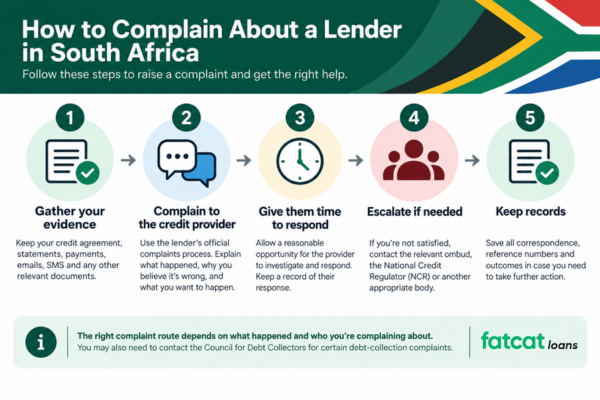
Step 1: Gather Your Evidence
Collect everything connected with the credit agreement and the problem you’re disputing.
This might include:
- your credit agreement;
- pre-agreement statement and quotation;
- account statements;
- proof of payments;
- debit-order records;
- emails;
- SMS or WhatsApp messages;
- screenshots;
- correspondence with the lender;
- reference numbers from previous complaints; and
- your credit report if the dispute involves information reported to a credit bureau.
Write down important dates as well.
If you’ve spoken to someone by telephone, record the date, approximate time, name of the person you spoke to and what was discussed.
Good records can make a significant difference when a complaint needs to be escalated.
Step 2: Check Your Credit Agreement
Before complaining, compare what actually happened with what your credit agreement says should happen.
Check:
- the amount borrowed;
- interest rate;
- initiation fee;
- monthly service fee;
- credit insurance, where applicable;
- repayment amount;
- number of repayments;
- repayment dates;
- total cost of credit; and
- any other charges appearing on your account.
If you’re disputing a particular transaction or fee, identify it specifically.
Instead of saying:
“You’re overcharging me.”
a stronger complaint would identify the amount, date and reason you believe the charge is incorrect.
Step 3: Complain to the Credit Provider
In many situations, the best first step is to give the credit provider an opportunity to investigate and resolve the problem.
Submit the complaint through its official complaints process.
Explain clearly:
What happened → why you believe it’s wrong → what evidence you have → what you want the lender to do.
For example, you might ask the lender to:
- explain a charge;
- correct an account;
- refund an incorrect debit;
- correct information reported to a credit bureau;
- provide documents;
- investigate how the loan was approved; or
- provide a written response to your complaint.
Ask for a complaint or reference number and keep it.
Where possible, submit your complaint in writing so you have evidence of exactly what was raised.
Step 4: Give the Provider a Reasonable Opportunity to Respond
Don’t immediately submit the same complaint to every regulator you can find.
Allow the provider’s complaints department to investigate the matter, unless the situation is urgent or there is another reason why immediate escalation is appropriate.
Keep copies of its responses.
If the provider resolves the issue, keep the written confirmation in case the problem reappears.
If it rejects your complaint or you’re not satisfied with the outcome, you can consider escalating it.
Step 5: Consider the National Financial Ombud
The National Financial Ombud Scheme South Africa (NFO) provides free, independent dispute-resolution services for consumers with complaints against participating financial institutions, including banks and credit providers.
Importantly, the NFO says you should first submit your complaint to the bank, insurer or credit provider concerned and go through its complaints process. If you’re still dissatisfied, you can approach the NFO.
The NFO may therefore be relevant where you’ve already tried to resolve a complaint directly with a participating bank or credit provider but haven’t reached a satisfactory outcome.
Its service is free to consumers.
This isn’t just a theoretical complaint route either. The NFO reported that 62% of complaints against credit companies resolved during 2025 were resolved in favour of consumers.
Step 6: Lodge a Complaint With the National Credit Regulator
The National Credit Regulator (NCR) regulates South Africa’s credit industry under the National Credit Act.
The NCR’s own consumer guidance states that consumers may lodge complaints relating to credit agreements with the regulator. Depending on the matter, the NCR may investigate the complaint or refer it to an appropriate body.
Complaints could potentially concern issues such as:
- reckless lending;
- unlawful credit practices;
- affordability assessments;
- prohibited charges;
- credit bureau information;
- conduct by registered credit providers; or
- other matters regulated by the NCA.
When submitting a complaint, provide as much supporting evidence as possible.
That includes your agreement, correspondence, statements and evidence showing that you already attempted to resolve the issue.
NFO or NCR: Who Should You Complain To?
It can be difficult to know which organisation to approach because the NFO, NCR and NCT have different roles.
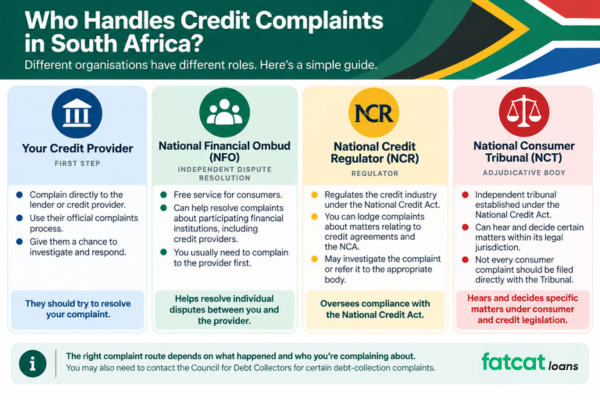
The correct route depends on what happened and who you’re complaining about.
For example, a dispute over how your bank handled your loan account may be suitable for the NFO after you’ve complained to the bank.
A complaint involving potential contraventions of the National Credit Act may fall within the NCR’s regulatory role.
And a complaint about the behaviour of a debt collector may involve the Council for Debt Collectors rather than the original lender.
The NCA itself recognises several possible complaint and dispute-resolution routes, including the NCR, an ombud with jurisdiction, the National Consumer Tribunal and alternative dispute resolution.
What Is the National Consumer Tribunal?
The National Consumer Tribunal (NCT) is an independent adjudicative body established under the National Credit Act.
It is different from the NCR.
A simple distinction is:
NCR = regulator
NCT = tribunal
The NCR regulates the credit industry and investigates certain complaints, while the Tribunal can hear and decide matters that fall within its legal jurisdiction.
Not every consumer complaint should be filed directly with the Tribunal, however. The appropriate route depends on the nature of the case and the provisions of the NCA.
What If the Problem Is Reckless Lending?
South Africa’s National Credit Act specifically prohibits reckless credit granting.
Before granting certain forms of credit, a credit provider is required to assess the consumer as required by the NCA and applicable regulations.
That doesn’t mean a loan is automatically reckless simply because you later struggle to repay it.
However, if you believe a lender granted you credit without properly considering your financial circumstances as required, it may be worth seeking guidance from the NCR, a registered debt counsellor or an appropriate legal professional.
If you’re already struggling with several repayments, our guide to debt consolidation loans in South Africa explains how consolidating debt differs from simply taking on additional borrowing.
What If a Lender Has Incorrectly Listed You With a Credit Bureau?
Incorrect credit information can affect your ability to borrow, rent property or access other financial products.
If information on your credit report appears incorrect, first identify exactly which account or entry you’re disputing.
Gather evidence such as:
- settlement letters;
- proof of payment;
- account statements;
- identity documents where appropriate; and
- correspondence with the credit provider.
You can then dispute inaccurate information through the appropriate credit bureau’s dispute process.
If the problem originated with the credit provider, you may also need to raise the matter directly with that provider.
Don’t pay someone simply because they promise they can “remove” accurate negative information from your credit profile. Legitimate negative information cannot necessarily be erased simply because you would prefer it not to appear.
What If a Debt Collector Is Harassing You?
There is a difference between legitimate debt collection and unlawful or inappropriate behaviour.
Owing money does not mean a collector can simply use any method it chooses to recover it.
If you’re contacted about a debt, establish:
- who the collector represents;
- which debt they’re referring to;
- the amount allegedly outstanding; and
- whether the collector is properly registered where registration is required.
Keep records of calls, messages and correspondence.
If you believe a registered debt collector has acted improperly, the Council for Debt Collectors may be the appropriate body to contact. NCR consumer guidance also identifies the Council as an organisation dealing with complaints relating to debt collection.
Threats or circumstances involving possible criminal conduct should be treated separately and may warrant contacting the police or obtaining legal advice.
What If Money Is Being Debited From Your Account Without Permission?
Don’t ignore an unfamiliar debit order.
Check the transaction and contact your bank and the organisation responsible for the debit as soon as possible.
Ask:
Who initiated the debit?
What agreement supposedly authorised it?
What is the payment for?
If the debit relates to a loan, compare it with your credit agreement.
Keep screenshots or bank statements showing the disputed transactions and retain correspondence about any reversal or dispute.
If the issue isn’t resolved through the financial institution’s complaint process, you may then need to escalate the matter to the appropriate dispute-resolution body.
What If a Lender Doesn’t Appear to Be Registered With the NCR?
If a credit provider should be registered with the NCR but you cannot verify its registration, treat this as a warning sign and investigate further before providing personal information or paying any money.
Before borrowing, consumers can check whether a credit provider is registered with the National Credit Regulator, where registration is required.
Be particularly cautious of someone offering loans through WhatsApp, Facebook or SMS while:
- promising guaranteed approval;
- asking for an upfront “release” or “insurance” payment;
- refusing to provide proper company details;
- providing no written credit agreement;
- asking you to transfer money to a personal account; or
- claiming a payment is required before your loan can be released.
These may indicate that you’re dealing with a loan scam rather than a legitimate credit dispute.
If you’ve already sent money or provided banking or identity information to a suspected scammer, contact your bank promptly and consider reporting the matter to the appropriate authorities.
Don’t Stop Paying a Legitimate Loan Just Because You’ve Complained
This deserves its own section because it could prevent a nasty mistake.
Submitting a complaint does not automatically cancel your credit agreement or suspend your repayment obligations.
Unless you’ve received appropriate confirmation, advice or a lawful order affecting your obligations, simply stopping payments could result in:
- missed-payment charges where permitted;
- collection activity;
- negative information being reported to credit bureaus; and
- potentially further enforcement action.
If you’re unable to afford your repayments rather than disputing the validity of the loan itself, the solution may be different.
You could consider speaking with a registered debt counsellor about your options if you’re over-indebted.
How to Write a Strong Complaint About a Credit Provider
A good complaint doesn’t need to sound like it was written by a lawyer.
It needs to be specific and supported by evidence.
Include:
Your details: Name and relevant account or loan reference.
What happened: Explain the problem chronologically.
Important dates: When the loan was taken out, when the disputed event occurred and when you contacted the provider.
The disputed amount: State exactly how much is involved, if applicable.
Supporting evidence: Attach agreements, statements, receipts, emails or screenshots.
Previous complaint: Include the reference number and response you received.
Requested outcome: Explain what you believe would resolve the issue.
Try to avoid sending a very long emotional account without clearly explaining what you’re asking the organisation to investigate.
What If Your Complaint Isn’t Resolved?
If you’ve complained to the provider and the issue remains unresolved, don’t assume you’ve reached the end of the road.
Depending on the issue, your next step could involve:
Credit provider → NFO → NCR → NCT or legal advice
But that isn’t a mandatory sequence for every dispute.
Different organisations have different powers and jurisdictions. The right route depends on whether you’re dealing with an individual dispute, an alleged breach of the National Credit Act, debt collection, incorrect credit information or another issue.
If significant money, legal action, repossession or complicated contractual issues are involved, consider obtaining independent legal advice.
How to Protect Yourself Before Taking Out a Loan
Resolving a dispute after something goes wrong can take time.
It’s much easier to check a lender and loan carefully before signing.
Before borrowing:
- Verify the credit provider’s details.
- Check NCR registration where applicable.
- Read the entire credit agreement.
- Check the interest rate and fees.
- Look at the total amount you’ll repay, not only the monthly instalment.
- Make sure you understand the repayment dates.
- Don’t borrow more than you can realistically afford.
- Keep a copy of everything you sign.
- Never pay an unknown person simply to “release” loan funds.
If you’re still comparing borrowing options, FatCat Loans allows you to compare loan options in South Africa from different providers rather than relying on the first offer you find.
Frequently Asked Questions
Where can I complain about a lender in South Africa?
Start by raising the complaint directly with the credit provider. Depending on the issue and provider, you may then be able to approach the National Financial Ombud, National Credit Regulator or another appropriate dispute-resolution body.
Can I complain to the National Credit Regulator?
Yes. Consumers can lodge complaints with the NCR about matters relating to credit agreements and the National Credit Act. The NCR may investigate the matter or, where appropriate, refer it elsewhere.
Is it free to complain to the National Financial Ombud?
Yes. The National Financial Ombud provides its dispute-resolution service to consumers free of charge. You generally need to complain to the financial services provider first before approaching the NFO.
Can I stop paying my loan while I dispute it?
A complaint does not automatically cancel your loan or suspend your repayment obligations. Don’t simply stop making payments without understanding the potential consequences or obtaining appropriate advice.
What should I do if a lender charged me the wrong amount?
Check your credit agreement and statements, identify the specific charge you dispute and complain to the credit provider in writing. Keep copies of your evidence and the provider’s response. If the matter isn’t resolved, consider escalating it to the appropriate ombud or regulator.
What can I do about incorrect information on my credit report?
You can dispute information you believe is inaccurate with the relevant credit bureau. You may also need to contact the credit provider that supplied the information and provide evidence supporting your dispute.
Can I complain about reckless lending?
The National Credit Act prohibits reckless credit granting. If you believe credit was granted without the assessment required by the Act, you can seek guidance from the NCR, a registered debt counsellor or an appropriate legal professional.
How do I know whether a lender is legitimate?
Check the company’s identity and contact details independently and verify its NCR registration where registration is required. Be particularly cautious of unsolicited loan offers, guaranteed approval and requests to pay money before loan funds are released.

The FatCat Loans Editorial Team delivers clear, accurate, and unbiased guidance on loans, credit, and personal finance in South Africa, in compliance with the National Credit Act. Our writers follow strict editorial standards to ensure every article is trustworthy, well-researched, and easy to understand, helping readers make confident financial decisions.