Payday Loans South Africa: The Complete Guide (2026)
July 08, 2026
Understanding Payday Loans in South Africa
Last Updated: July 2026
Unexpected expenses can happen to anyone. Your car breaks down before payday, your child needs emergency medical treatment, or an important household appliance suddenly stops working. When savings aren’t enough to cover the cost, many South Africans begin searching for payday loans as a quick way to access cash.
While payday loans can provide fast financial relief, they are not always the best solution. They can be one of the most expensive forms of borrowing if you don’t fully understand the costs, repayment terms and potential risks.
That’s why it’s important to make an informed decision before applying.
This guide explains everything you need to know about payday loans in South Africa, including:
- What payday loans are
- How they work
- Who qualifies
- Typical loan amounts
- Interest rates and fees
- How affordability checks work
- The advantages and disadvantages
- How to avoid loan scams
- Safer alternatives to payday loans
Whether you’re borrowing for the first time or simply comparing your options, this guide will help you understand your rights and responsibilities under South African credit law.
Table of Contents
- What Are Payday Loans?
- Are Payday Loans Legal in South Africa?
- How Do Payday Loans Work?
- Who Qualifies for a Payday Loan?
- What Documents Do You Need?
- How Much Can You Borrow?
- The True Cost of Payday Loans
- How Interest Rates Work
- Can You Get a Payday Loan with Bad Credit?
- What Is an Affordability Assessment?
- How Long Does Approval Take?
- What Are the Advantages and Disadvantages of Payday Loans?
- Payday Loans vs Personal Loans
- Payday Loans vs Short-Term Loans
- Will a Payday Loan Affect Your Credit Score?
- Common Payday Loan Myths
- Common Borrowing Mistakes to Avoid
- Can You Repay a Payday Loan Early?
- How to Spot and Avoid Payday Loan Scams
- What Happens If You Can’t Repay Your Payday Loan?
- Alternatives to Payday Loans
- How to Compare Payday Loans
- Responsible Borrowing Checklist
- Who Should Consider a Payday Loan?
- When a Payday Loan May Not Be the Right Choice
- Conclusion
- Related Guides
- Frequently Asked Questions
Payday Loans South Africa at a Glance
| Feature | Typical Information |
|---|---|
| Loan amount | R500 – R8,000 (varies by lender) |
| Repayment period | Usually 1–6 months |
| Security required | No |
| Credit check | Usually required |
| Approval time | Often within minutes |
| Funding | Sometimes the same business day |
| Regulated | Yes, under the National Credit Act |
Good to know: FatCat Loans is a loan comparison platform. We don’t lend money directly. Instead, we help South Africans compare loan options from trusted lenders so they can make informed borrowing decisions.
We don’t influence lending decisions or guarantee approval. Each lender assesses applications individually based on its own eligibility and affordability criteria.
What Are Payday Loans?
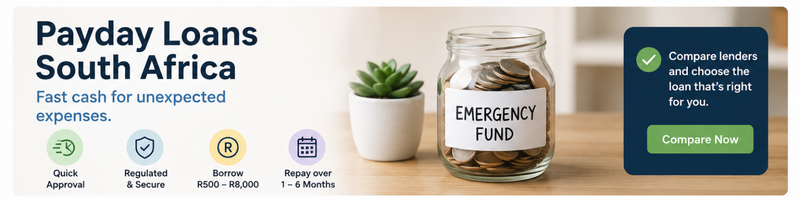
A payday loan is a small, short-term unsecured loan designed to help you cover unexpected expenses until your next salary or another source of income becomes available.
Unlike larger personal loans that are repaid over several years, payday loans are intended for short-term financial needs. They usually involve borrowing a relatively small amount and repaying it over a shorter period, together with interest and any applicable fees.
People commonly use payday loans for situations such as:
- Emergency vehicle repairs
- Medical expenses
- Essential household repairs
- School costs
- Utility bills
- Temporary cash flow shortages
- Unexpected travel expenses
Because these loans are usually processed online, many lenders can provide an approval decision within minutes once all required documents have been submitted.
However, quick approval should never be the only reason for choosing a lender. It’s equally important to understand the total cost of the loan and ensure you can comfortably repay it.
Are Payday Loans Legal in South Africa?
Yes.
Payday loans are legal in South Africa, but only when offered by lenders that comply with the National Credit Act (NCA) and are registered with the National Credit Regulator (NCR).
These laws were introduced to protect consumers from unfair lending practices and ensure that credit is provided responsibly.
Before approving a loan, registered lenders must:
- Verify your identity
- Assess your income
- Review your monthly expenses
- Determine whether you can afford the repayments
- Clearly disclose all costs before you accept the loan
This process is known as an affordability assessment, and it helps reduce the risk of borrowers taking on debt they cannot realistically repay.
If a lender skips these checks or asks you to pay money before your loan is approved, this should be treated as a serious warning sign.
Always borrow from an NCR-registered lender. You can verify a lender’s registration by visiting the National Credit Regulator website.
How Do Payday Loans Work?
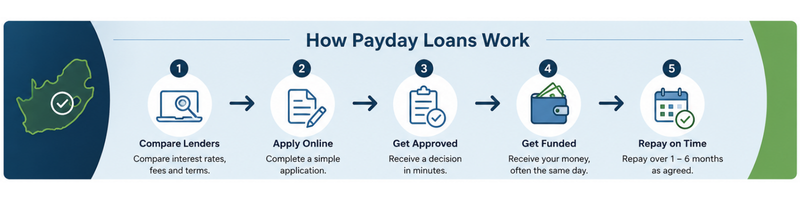
Although every lender has its own application process, payday loans generally follow the same basic steps.
Step 1: Compare lenders
Instead of applying to the first lender you find, compare several options first.
Look at:
- Interest rates
- Fees
- Loan amounts
- Repayment terms
- Customer reviews
- NCR registration
Using a loan comparison service can save both time and money by helping you compare lenders, interest rates, repayment terms and loan features in one place before you apply.
Step 2: Complete an online application
Most lenders allow you to apply online in just a few minutes.
You’ll usually provide:
- Your name
- South African ID number
- Employment information
- Monthly income
- Banking details
- Contact information
Step 3: Submit supporting documents
Most lenders require documents such as:
- South African ID
- Recent payslip or proof of income
- Three months’ bank statements
- Proof of residence (where required)
Some lenders may ask for additional documentation depending on your circumstances.
Step 4: Affordability assessment
This is one of the most important parts of the application process.
The lender reviews your income and existing financial commitments to determine whether you can reasonably afford another loan.
Factors that may be considered include:
- Monthly salary
- Existing loans
- Credit card repayments
- Household expenses
- Dependants
- Credit history
Being approved isn’t just about earning enough money. The lender must also be satisfied that the repayments won’t place you under financial strain.
Why Affordability Assessments Matter
Affordability assessments are designed to protect both borrowers and lenders. Rather than encouraging people to take on debt they cannot manage, responsible lenders assess whether the repayments are likely to fit within your monthly budget. While being declined can be disappointing, these checks help reduce the risk of long-term financial difficulties and are an important part of responsible lending under the National Credit Act.
Step 5: Receive a lending decision
If your application is approved, you’ll receive a loan offer explaining:
- The amount approved
- Interest rate
- Initiation fees
- Monthly service fees
- Total repayment amount
- Repayment dates
Read this information carefully before accepting the offer.
Step 6: Receive your funds
Once you’ve accepted the loan agreement, the lender arranges payment.
Many lenders advertise same-day payouts, although the actual time depends on:
- The time your application is approved
- Bank processing times
- Public holidays
- Weekends
- Whether all required documents were submitted correctly
Who Qualifies for a Payday Loan?
Eligibility requirements vary between lenders, but most require applicants to meet the following criteria.
You will usually need to:
- Be at least 18 years old
- Be a South African citizen or permanent resident
- Have a valid South African ID
- Earn a regular income
- Have an active South African bank account
- Meet the lender’s affordability requirements
Some lenders also consider self-employed applicants, pensioners and people with alternative sources of income, although additional documentation may be required.
What Documents Do You Need?
Having your documents ready can speed up the application process considerably.
Most lenders ask for:
| Document | Why it’s required |
|---|---|
| South African ID | Verify your identity |
| Latest payslip | Confirm your income |
| Three months’ bank statements | Assess affordability |
| Proof of residence | Verify your address (where required) |
Some lenders may also request:
- Employment confirmation
- SARS documents
- Proof of self-employment income
- Pension statements
Providing accurate information helps prevent unnecessary delays.
How Much Can You Borrow?
Payday loans are intended for smaller, short-term borrowing rather than major purchases.
The amount you qualify for depends on several factors, including:
- Your monthly income
- Existing financial commitments
- Your affordability assessment
- Your credit profile
- The lender’s lending policies
Loan amounts vary between lenders and depend on your income, affordability assessment and the lender’s lending criteria. Many payday-style loans start from around R500, while some lenders may offer larger short-term loans to qualifying borrowers.
Remember that borrowing more than you genuinely need will increase the total amount you repay through interest and fees.
Responsible borrowing tip: Only borrow the amount you need—not the maximum amount you’re offered.
Why Do People Choose Payday Loans?
Despite their higher costs, payday loans remain popular because they offer several practical benefits when used responsibly.
Many borrowers choose them because they provide:
- Fast online applications
- Quick approval decisions
- No security or collateral
- Convenient online document uploads
- Smaller loan amounts
- Short repayment periods
- Access to emergency funds
For someone facing an urgent expense, these advantages can make payday loans an attractive option.
However, speed should never outweigh affordability. Before accepting any loan, take the time to compare lenders, understand the total repayment amount and consider whether there may be a cheaper alternative.
The True Cost of Payday Loans
One of the biggest mistakes borrowers make is focusing only on the amount they want to borrow.
For example, borrowing R2,000 might seem affordable at first, but the total amount you repay can be significantly higher once interest, initiation fees, monthly service fees and VAT are included.
Before accepting any loan, always ask yourself one question:
“How much money will leave my bank account in total?”
That figure—not the loan amount—is what really matters.
What Makes Up the Total Cost?
The total cost of a payday loan usually includes:
| Cost | What It Means |
|---|---|
| Loan amount | The amount you borrow |
| Interest | Charged according to the loan agreement and legal limits |
| Initiation fee | A once-off fee charged when the loan starts |
| Monthly service fee | A monthly administration fee (where applicable) |
| VAT | Applied to certain fees under South African tax law |
Every lender must clearly disclose these costs before you accept a loan agreement.
If the costs are unclear or seem confusing, ask questions before signing anything.
Example Cost Breakdown
The exact figures vary between lenders and depend on the amount borrowed and the repayment period, but a loan could look something like this:
| Example Loan | Amount |
|---|---|
| Loan amount | R2,000 |
| Interest | Varies |
| Initiation fee | Regulated maximum applies |
| Monthly service fee | Regulated maximum applies |
| VAT on applicable fees | Applicable |
| Total repayment | More than the original amount borrowed |
The important takeaway is simple:
Never compare loans using the interest rate alone.
Looking at the full repayment amount can help you understand the real cost of borrowing. Using a loan calculator before you apply is one of the easiest ways to compare different loan amounts and repayment terms.
Instead, compare:
- Total repayment
- Monthly instalment
- All fees
- Repayment period
Sometimes a loan with a slightly higher interest rate can actually cost less overall because of lower fees.
Illustrative Repayment Example
The example below is for illustration purposes only. Actual repayments vary depending on the lender, loan amount, repayment period, interest rate and applicable fees.
| Example | Amount |
|---|---|
| Loan amount | R2,000 |
| Repayment period | 3 months |
| Monthly repayment | Varies |
| Total repayment | Depends on interest and fees |
Understanding the total repayment is just as important as knowing how much you want to borrow. A loan calculator can help you estimate your monthly repayments, compare different borrowing scenarios and decide whether a loan is likely to fit comfortably within your budget before you apply.
How Interest Rates Work
Interest is the cost of borrowing money.
In South Africa, credit providers must comply with the National Credit Act (NCA) and the regulations governing the maximum interest and fees that may be charged for different types of credit.
However, the maximum legal rate isn’t necessarily the rate every lender charges.
Different lenders consider factors such as:
- Your credit profile
- Income
- Existing debt
- Loan amount
- Repayment term
- Overall affordability
Always compare several lenders before making a decision.
Fixed vs Variable Costs
When comparing loan offers, you’ll usually see two different types of charges.
Fixed costs
These usually remain the same regardless of how quickly you repay.
Examples include:
- Initiation fees
- Administrative charges
Variable costs
These depend on the size of the loan or how long you keep it.
Examples include:
- Interest
- Monthly service fees
Understanding this difference makes it much easier to compare loan offers fairly.
Can You Get a Payday Loan with Bad Credit?
Many people believe having a poor credit score automatically means they’ll be declined.
That’s not always true.
While every lender has its own lending criteria, many consider much more than your credit score alone.
They may also assess:
- Your monthly income
- Employment stability
- Existing debt
- Affordability
- Recent repayment history
A lower credit score doesn’t necessarily prevent approval if you can demonstrate that you can comfortably afford the repayments.
However, applicants with severe payment defaults, debt review, judgments or very high levels of existing debt may find it more difficult to qualify.
Need help comparing your options? If you have a less-than-perfect credit history, explore our guide to Bad Credit Loans in South Africa to learn which lenders may consider your application.
What Is an Affordability Assessment?
Before approving any regulated loan, lenders must determine whether you can realistically afford the repayments.
This process protects both you and the lender.
During an affordability assessment, the lender may review:
- Your monthly salary
- Living expenses
- Existing loans
- Credit cards
- Store accounts
- Insurance payments
- Number of dependants
- Disposable income
If the assessment shows that another loan would place you under financial pressure, the lender may decline the application.
Although this can be disappointing, responsible lending helps reduce the risk of long-term debt problems.
How Long Does Approval Take?
One reason payday loans remain popular is speed.
Many online lenders provide decisions within minutes after receiving all required documents.
However, approval is only part of the process.
Your funds may arrive later depending on:
- Banking hours
- Public holidays
- Weekends
- Identity verification
- Document checks
- Internal processing times
Submitting clear, accurate documents can help avoid unnecessary delays.
What Are the Advantages and Disadvantages of Payday Loans?
Advantages
When used responsibly, payday loans can provide valuable short-term financial assistance.
Some of the benefits include:
Fast applications
Many lenders allow you to apply entirely online.
Quick decisions
Approval may be provided within minutes.
Small loan amounts
Borrow only what you need rather than taking on a large personal loan.
No collateral
Most payday loans are unsecured, meaning you don’t have to use your vehicle or property as security.
Emergency financial support
They can help cover unexpected costs until your next payday.
Disadvantages
Payday loans also have important disadvantages that every borrower should understand.
Higher borrowing costs
Short-term loans are often more expensive than larger personal loans.
Short repayment periods
Repayments begin quickly, which can place pressure on your monthly budget.
Risk of repeat borrowing
Some borrowers take out another loan simply to repay the previous one, creating a difficult cycle of debt.
Impact on your credit profile
Missing repayments may affect your credit record and make future borrowing more difficult.
Financial pressure
Borrowing more than you can comfortably repay can increase financial stress.
For these reasons, payday loans should generally be viewed as a solution for genuine emergencies rather than regular monthly expenses.
Payday Loans vs Personal Loans
Many borrowers aren’t sure which type of loan best suits their needs.
Here’s a simple comparison.
| Payday Loan | Personal Loan |
|---|---|
| Smaller loan amounts | Usually larger loan amounts |
| Short repayment period | Longer repayment period |
| Often used for emergencies | Suitable for planned expenses |
| Higher cost per Rand borrowed | Often lower cost over time |
| Faster application process | May involve additional checks |
If you need to borrow a larger amount for home improvements, education or debt consolidation, a personal loan may offer better value.
If you need a smaller amount for an unexpected emergency, a payday loan could be more suitable—provided you can comfortably repay it.
Payday Loans vs Short-Term Loans
Many South Africans use these terms interchangeably, but they aren’t always exactly the same.
| Payday Loan | Short-Term Loan |
|---|---|
| Traditionally repaid around your next payday | May be repaid over several months |
| Usually smaller borrowing amounts | Often offers greater flexibility |
| Emergency cash flow | Wider range of borrowing purposes |
| Short repayment schedule | May have slightly longer repayment options |
Today, many lenders market products as short-term personal loans rather than payday loans, even though they serve a similar purpose.
Will a Payday Loan Affect Your Credit Score?
A payday loan can affect your credit profile—but not always in a negative way.
Positive effects
Making every repayment on time may demonstrate responsible borrowing behaviour.
Negative effects
Late or missed repayments can:
- Lower your credit score
- Increase future borrowing costs
- Make it harder to qualify for new credit
- Lead to collection activity
If you experience financial difficulties, contact your lender as early as possible rather than ignoring the problem.
Common Payday Loan Myths
There are many misconceptions about payday loans. Understanding the facts can help you make a more informed borrowing decision.
Myth: Payday loans are always approved.
Reality: Every application is subject to affordability checks, and approval is never guaranteed.
Myth: Bad credit means you can’t get a loan.
Reality: Some lenders consider your affordability and overall financial situation as well as your credit history.
Myth: All payday loans cost the same.
Reality: Interest rates, fees and repayment terms can vary between lenders, making it important to compare your options.
Myth: A payday loan is the only solution.
Reality: Depending on your circumstances, alternatives such as short-term loans, personal loans or salary advances may be more suitable.
Common Borrowing Mistakes to Avoid
Many financial difficulties can be avoided by steering clear of these common mistakes.
Borrowing more than you need
Only borrow the amount required to solve the immediate problem.
Ignoring the total repayment
Always compare the total amount you’ll repay—not just the monthly instalment.
Applying to multiple lenders at once
Submitting many applications within a short period may affect how lenders view your creditworthiness.
Missing repayments
Late payments can lead to additional costs and damage your credit profile.
Borrowing for non-essential spending
Avoid using payday loans for holidays, luxury purchases or discretionary spending.
Not reading the loan agreement
Always understand the fees, repayment dates and terms before accepting a loan.
Can You Repay a Payday Loan Early?
In many cases, yes.
Depending on your loan agreement and applicable legislation, you may be able to settle your loan before the scheduled end date.
Early settlement can sometimes reduce the amount of interest you pay, although this depends on the lender and the specific terms of your agreement.
If you have extra funds available, ask your lender for a settlement quotation before making an early payment.
How to Spot and Avoid Payday Loan Scams
Unfortunately, scammers often target people who urgently need money. They promise guaranteed approval, instant payouts or “no credit checks” to convince borrowers to hand over money or personal information.
Knowing the warning signs can help you avoid becoming a victim.
Upfront Fee Scams
One of the most common scams involves asking borrowers to pay an “administration fee”, “insurance fee” or “release fee” before the loan is paid out.
Legitimate lenders do not ask you to pay money upfront to receive your loan.
Any legal fees or charges are included in your loan agreement and repayment schedule—not paid in advance.
If someone asks you to pay before receiving your loan, walk away.
Fake Loan Companies
Some scammers create professional-looking websites and social media pages that imitate genuine lenders.
Always check that the lender is:
- Registered with the National Credit Regulator (NCR)
- Has a legitimate website
- Has a physical business address
- Has genuine customer reviews
- Clearly displays its contact information
You can verify whether a lender is registered by searching the National Credit Regulator’s register.
WhatsApp and Facebook Loan Scams
Be cautious of advertisements promising:
- Guaranteed approval
- No affordability checks
- Instant cash regardless of your credit history
- Loans without documentation
- “Special insider approvals”
These offers are often designed to collect your identity documents or steal money through fake fees.
Identity Theft
Never send copies of your ID, bank card or banking passwords to anyone through WhatsApp or social media.
Only upload documents through secure application portals provided by legitimate lenders.
Stay safe: If an offer sounds too good to be true, it probably is.
What Happens If You Can’t Repay Your Payday Loan?
Financial situations can change unexpectedly. Losing your job, unexpected medical expenses or reduced income can make repayments difficult.
Ignoring the problem usually makes it worse.
If you think you may struggle to repay your loan:
- Contact your lender as soon as possible.
- Explain your situation honestly.
- Ask whether alternative repayment arrangements are available.
- Avoid taking out another loan simply to repay the first one.
Missing repayments may result in:
- Additional charges (where legally permitted)
- Negative information being recorded on your credit profile
- Collection activity
- Possible legal action
The earlier you communicate with your lender, the more options you may have.
If you’re struggling with several existing repayments, comparing debt consolidation loans may also be worth considering.
Alternatives to Payday Loans
A payday loan isn’t the only option when you need money quickly.
Depending on your circumstances, one of these alternatives may be more suitable.
Short-Term Personal Loans
Some lenders offer short-term loans in South Africa with more flexible repayment periods than traditional payday loans. Comparing these options may help you find a loan that’s better suited to your needs and budget.
Personal Loans
If you need to borrow a larger amount or would prefer a longer repayment period, it may be worth exploring personal loans in South Africa before deciding whether a payday loan is the right option for your circumstances.
Salary Advances
Some employers allow staff to access part of their salary before payday.
Unlike payday loans, salary advances often involve little or no interest.
Borrowing from Family or Friends
Although it may feel uncomfortable, borrowing from someone you trust can sometimes be a lower-cost solution.
If you do, agree on repayment terms in writing to avoid misunderstandings.
Emergency Savings
Building even a small emergency fund can reduce the need for borrowing in the future.
Saving a little each month—even R100 or R200—can make a significant difference over time.
How to Compare Payday Loans
Not all payday loans are the same.
Before choosing a lender, compare the following:
| What to Compare | Why It Matters |
|---|---|
| Total repayment | Shows the true cost of borrowing |
| Interest and fees | Helps identify better-value loans |
| Repayment period | Affects your monthly budget |
| NCR registration | Confirms the lender is regulated |
| Customer reviews | Provides insight into service quality |
| Funding speed | Important for genuine emergencies |
| Early settlement options | May reduce borrowing costs |
Avoid choosing a loan based solely on the fastest approval or the largest amount offered.
Responsible Borrowing Checklist
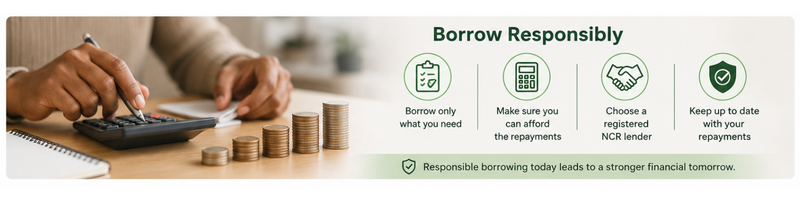
Before submitting your application, ask yourself these questions:
- Do I genuinely need this loan?
- Have I compared more than one lender?
- Can I comfortably afford the repayments?
- Do I understand all the fees and charges?
- Is the lender registered with the National Credit Regulator?
- Have I considered cheaper alternatives?
- Am I borrowing only what I need?
If you answer “no” to any of these questions, spend some time reviewing your options before applying.
Who Should Consider a Payday Loan?
A payday loan may be appropriate if:
- You have an unexpected emergency expense.
- You need a relatively small amount of money.
- You have a regular income.
- You’re confident you can repay the loan on time.
- You’ve compared several lenders.
When a Payday Loan May Not Be the Right Choice
You should think carefully before borrowing if:
- You’re already struggling to pay existing debts.
- You’re under debt review.
- You need the loan for non-essential spending.
- You’re borrowing to repay another loan.
- You don’t know how you’ll make the repayments.
In these situations, speaking to a financial adviser or debt counsellor may be a better first step.
Conclusion
A payday loan can provide valuable financial support when you’re faced with an unexpected expense, but it should never be viewed as a long-term solution.
Before applying, take the time to compare lenders, understand the full cost of borrowing and make sure the repayments fit comfortably within your monthly budget. Borrow only what you need and only if you’re confident you can repay the loan on time.
At FatCat Loans, we help South Africans compare loan options from trusted lenders so they can make informed borrowing decisions. We’re here to help you compare loan options so you can make an informed borrowing decision.
Taking a few extra minutes to compare lenders, understand the full cost of borrowing and choose a loan that fits your budget can help you avoid unnecessary financial stress and make more confident borrowing decisions.

Related Guides
You may also find these guides helpful before applying for a loan:
- Compare Loans
- Short-Term Loans
- Personal Loans
- Bad Credit Loans
- Loan Calculator
- No Credit Check Loans
- Fraud Alert
Frequently Asked Questions
Are payday loans legal in South Africa?
Yes. Payday loans are legal when provided by lenders that comply with the National Credit Act and are registered with the National Credit Regulator (NCR).
How much can I borrow?
Loan amounts vary between lenders and depend on your income, affordability and credit profile. Many payday loans range from approximately R500 to R8,000.
How quickly can I receive the money?
Many lenders provide approval decisions within minutes, and some can pay out funds on the same business day once your application has been approved.
Can I get a payday loan with bad credit?
Possibly. Some lenders consider applicants with less-than-perfect credit histories, but approval also depends on affordability, income and other lending criteria.
Will applying affect my credit score?
Lenders may perform a credit enquiry as part of the application process. Multiple applications within a short period may affect how future lenders assess your application.
What documents do I need?
Most lenders ask for a valid South African ID, proof of income, recent bank statements and, in some cases, proof of residence.
Do I need collateral?
No. Payday loans are generally unsecured, so you don’t normally need to provide a vehicle or property as security.
Can I repay my loan early?
Many lenders allow early settlement. Contact your lender to request a settlement quotation and confirm whether early repayment could reduce the total cost.
Can self-employed people apply for a payday loan?
Some lenders consider applications from self-employed borrowers. You may be asked to provide additional documents, such as recent bank statements, invoices or proof of regular income, instead of traditional payslips.
Can pensioners apply for a payday loan?
Some lenders accept applications from pensioners who receive a regular income and meet the lender’s affordability requirements. Eligibility varies between lenders.
What happens if I miss a repayment?
Missing repayments may lead to additional charges, collection activity and negative information being recorded on your credit profile. Contact your lender immediately if you’re experiencing financial difficulty.
How do I know if a lender is legitimate?
Check that the lender is registered with the National Credit Regulator and never pay upfront fees to receive a loan.
Are payday loans the same as short-term loans?
Not always. Payday loans are a type of short-term loan, but many lenders now offer short-term personal loans with more flexible repayment periods.
Are there alternatives to payday loans?
Yes. Alternatives include short-term personal loans, personal loans, salary advances and borrowing from family members, depending on your circumstances.

The FatCat Loans Editorial Team delivers clear, accurate, and unbiased guidance on loans, credit, and personal finance in South Africa, in compliance with the National Credit Act. Our writers follow strict editorial standards to ensure every article is trustworthy, well-researched, and easy to understand, helping readers make confident financial decisions.