How Much Do Payday Loans Cost in South Africa? Interest Rates & Fees Explained
October 08, 2026
How Much Do Payday Loans Cost in South Africa?
Last Updated: October 2026
Payday loans may seem like a convenient way to cover an unexpected expense before your next salary arrives. But how much does a payday loan actually cost in South Africa?
The answer depends on more than the amount you borrow or the interest rate advertised by the lender.
A payday loan can include interest, an initiation fee, a monthly service fee, VAT on applicable fees and other charges permitted under South African credit law.
These costs can make a relatively small loan surprisingly expensive.
For example, borrowing R3,000 does not necessarily mean you’ll repay just R3,000 plus a little interest. Once the fees are included, the amount leaving your bank account could be considerably higher.
This guide explains how payday loan costs work, the legal limits that may apply, and what borrowing R1,000, R3,000 or R5,000 could cost using illustrative repayment examples.
If you’re new to this type of borrowing, start with our complete guide to payday loans in South Africa to understand how these loans work, who may qualify and the risks involved.
Payday Loan Costs in South Africa at a Glance
The total cost of a payday loan depends on the legal classification of the agreement, the lender’s charges and your repayment terms.
| Cost | What You Need to Know |
|---|---|
| Interest | Qualifying short-term credit transactions have a maximum rate of 5% per month for a first loan and 3% per month for subsequent loans in the same calendar year |
| Initiation fee | A once-off fee subject to regulated limits |
| Service fee | Up to R60 per month under the prescribed limit, excluding applicable VAT |
| VAT | Generally applies to initiation and service fees |
| Credit insurance | May apply where permitted and included in the agreement |
| Late-payment costs | Additional permitted interest and collection costs may arise if you fail to repay |
| Total repayment | Depends on the loan amount, term, interest calculation and all applicable charges |
Important: These interest limits apply to agreements legally classified as short-term credit transactions under the National Credit Act. A product marketed as a payday loan may fall into a different legal category. Always check the classification and terms of the actual credit agreement.
What Makes Up the Total Cost of a Payday Loan?
The amount you repay can be divided into several components.
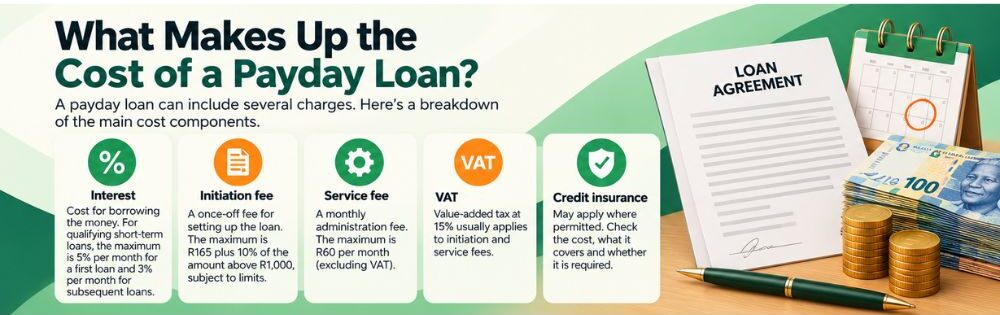
1. Interest on the Money Borrowed
Interest is the amount a lender charges for allowing you to borrow money.
Under South Africa’s National Credit Act regulations, qualifying short-term credit transactions are subject to prescribed maximum interest rates.
These include:
- First qualifying short-term loan: Maximum 5% per month.
- Subsequent qualifying short-term loans within the same calendar year: Maximum 3% per month.
These are maximum permitted rates, not rates every lender must charge.
A lender may charge less, and the rate applicable to your agreement depends on its legal classification.
For a simple illustration, borrowing R3,000 at 5% for one month produces R150 in interest, assuming interest is calculated on the R3,000 principal for the full month.
That doesn’t include initiation fees, service fees or VAT.
2. Initiation Fees
An initiation fee is a once-off charge associated with setting up a credit agreement.
For a qualifying short-term credit transaction, the prescribed initiation-fee formula is:
R165 plus 10% of the principal amount above R1,000, subject to the applicable maximum and the separate limit of 15% of the principal debt.
This means the maximum permitted initiation fee varies depending on the loan amount.
For example:
| Loan amount | Illustrative maximum initiation fee, excluding VAT |
|---|---|
| R1,000 | R150 |
| R3,000 | R365 |
| R5,000 | R565 |
The R1,000 example is limited to R150 because of the 15% cap.
These are examples of the maximum fee under the stated rules, not a prediction of what a particular lender will charge.
An initiation fee should be disclosed before you enter into the agreement. It cannot be charged merely because you submitted an unsuccessful application.
3. Monthly Service Fees
A service fee covers the administration of the credit agreement.
The prescribed maximum is R60 per month, excluding applicable VAT.
If a lender charges the full R60 and VAT is charged at 15%, the amount becomes R69.
For a short loan, that may not seem significant. However, on a R1,000 loan, a R69 service fee represents a noticeable additional cost.
Service fees must follow the applicable regulations, including relevant rules about when and how they are charged.
4. VAT on Applicable Fees
VAT can increase the amount you repay.
In South Africa, VAT generally applies to credit-related initiation and service fees, while interest on the credit itself is generally exempt.
For example, a R365 initiation fee becomes R419.75 after 15% VAT.
When reviewing a quotation, check whether the displayed fees already include VAT. Otherwise, you may underestimate the final repayment.
5. Credit Insurance and Other Permitted Charges
Some credit agreements may include credit life insurance or other charges permitted under the National Credit Act.
Credit insurance may provide specified protection if certain events affect your ability to repay, depending on the policy.
Before accepting a loan, ask:
- Is credit insurance included or required?
- How much does it cost?
- What events does it cover?
- Are there exclusions or waiting periods?
- Are there any additional permitted charges?
Not every payday loan includes insurance, so don’t assume it will automatically form part of your repayment.
How Much Does a R1,000, R3,000 or R5,000 Payday Loan Cost?
The following examples show how interest and fees can affect the total repayment of a relatively small loan.
To make the calculations comparable, we’ve used the same assumptions for all three examples.
Assumptions
- Each loan is a qualifying short-term credit transaction.
- The borrower is taking their first qualifying short-term loan in the calendar year.
- The loan runs for one full month.
- Interest is calculated at 5% of the original principal for that month.
- The lender charges the maximum initiation fee permitted by the formula and 15% cap.
- A full R60 service fee is charged.
- VAT is 15% on the initiation and service fees.
- No credit insurance, additional charges or late-payment costs are included.
- Fees are assumed to be paid with the final repayment rather than financed and charged interest.
These examples are illustrative calculations, not lender quotations or representative market offers.
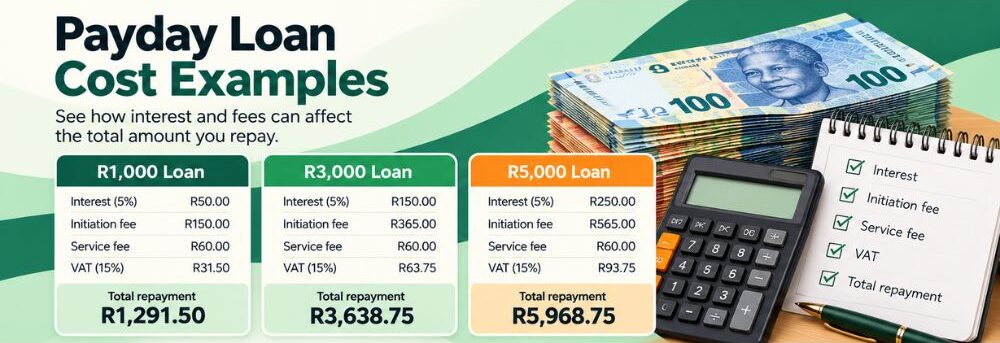
Payday Loan Cost Comparison
| Cost breakdown | R1,000 loan | R3,000 loan | R5,000 loan |
|---|---|---|---|
| Amount borrowed | R1,000.00 | R3,000.00 | R5,000.00 |
| One month’s interest at 5% | R50.00 | R150.00 | R250.00 |
| Initiation fee | R150.00 | R365.00 | R565.00 |
| Service fee | R60.00 | R60.00 | R60.00 |
| VAT on fees | R31.50 | R63.75 | R93.75 |
| Total borrowing cost | R291.50 | R638.75 | R968.75 |
| Total repayment | R1,291.50 | R3,638.75 | R5,968.75 |
The table demonstrates why looking at interest alone can be misleading.
For the R1,000 example, the interest is only R50, but the total borrowing cost reaches R291.50 once the assumed fees and VAT are included.
That represents approximately 29.15% of the amount borrowed over the one-month example period.
This is not an annual percentage rate (APR). It is simply the total illustrated borrowing cost divided by the original loan amount.
Actual lender quotations may be lower or calculated differently depending on the agreement, fees and payment schedule.
Why Smaller Payday Loans Can Be Expensive
One of the biggest disadvantages of borrowing a small amount is that fixed fees can represent a large proportion of the loan.
Consider the R1,000 example.
The R60 service fee and the once-off initiation fee are significant compared with the amount borrowed.
Even though the interest charge is relatively small in rand terms, the additional fees increase the overall cost.
This is why borrowers should be careful about comparing payday loans using only the advertised monthly interest rate.
A useful question is:
How much extra will I pay for every R1,000 I actually receive?
The answer should include every applicable charge, not just interest.
Does a Longer Payday Loan Term Cost More?
Often, yes.
Extending the repayment period can increase the amount of interest charged and may result in additional service fees.
However, the exact calculation depends on how the lender structures the agreement.
For example, a loan repaid in a single payment after one month may have a different cost from a loan repaid in three instalments.
If instalments reduce the outstanding principal over time, the interest calculation may differ from a single-payment loan.
The total cost can also depend on whether initiation fees are financed, how interest accrues and which monthly fees apply.
Before choosing a longer repayment period, compare:
- The amount you receive.
- The number of repayments.
- The amount of each repayment.
- The total interest and fees.
- The full amount repayable.
A lower monthly instalment may feel more manageable, but it doesn’t automatically make the loan cheaper.
For a broader explanation of the trade-offs, read Payday Loans vs Personal Loans in South Africa.
Are Payday Loan Interest Rates Legal in South Africa?
Yes. Registered credit providers may charge interest and permitted fees, provided they comply with the National Credit Act and applicable regulations.
However, lenders cannot simply charge any interest rate they choose.
South African credit law places limits on different types of credit agreements.
For example, the interest-rate cap for a qualifying short-term credit transaction differs from the cap applicable to an unsecured credit transaction.
The term payday loan is a marketing description, not by itself a legal credit category.
This means you should not assume that every loan advertised as a payday loan is subject to exactly the same rate structure.
When checking a lender’s offer, confirm:
- The registered credit provider’s identity and NCR registration details.
- The legal classification of the agreement.
- The interest rate and how it is calculated.
- All initiation, service and other permitted fees.
- The total repayment and due dates.
If a lender’s charges appear excessive, ask for a full explanation and check the relevant rules with the National Credit Regulator.
How to Compare Two Payday Loan Offers
Imagine two lenders each offer you R3,000.
Lender A advertises a lower interest rate but charges higher permitted fees.
Lender B charges more interest but has lower fees.
The cheaper interest rate does not necessarily mean Lender A offers the lower total cost.
To compare fairly, both quotations should be based on the same amount borrowed and the same repayment period.
Use the following checklist.
| What to compare | Why it matters |
|---|---|
| Amount received | Confirms how much money you actually get |
| Interest rate | Shows the charge for borrowing |
| Initiation fee | Adds to the once-off borrowing cost |
| Service fee | May increase costs over the repayment period |
| Insurance | May add to the repayment amount |
| VAT | Affects applicable fees |
| Repayment dates | Determines when the money must be available |
| Total repayable | Shows the overall financial commitment |
The most useful comparison is generally the total amount repayable, provided you’re comparing the same loan amount and repayment schedule.
You can also use FatCat Loans’ True Cost of Borrowing Calculator to explore how interest rates, repayment periods and fees affect estimated borrowing costs.
Remember that calculator results are estimates and may not reproduce the precise calculation method used in a particular short-term credit agreement.
What Happens If You Miss a Payday Loan Repayment?
Missing a repayment can make an already expensive loan more difficult to manage.
Depending on the agreement and applicable law, consequences may include:
- Permitted default interest.
- Lawful collection costs.
- Negative information being reported to credit bureaus.
- Contact from the lender or an authorised debt collector.
- Further collection or legal action if the debt remains unpaid.
The National Credit Act regulates default charges and collection procedures. A lender cannot impose unlimited penalties simply because you missed a payment.
However, falling behind can still create significant financial pressure.
Why Repeated Payday Borrowing Is Risky
A common problem occurs when someone uses most of their next salary to repay a payday loan.
They may then have too little money left for rent, groceries, transport or other essentials.
Taking another short-term loan to cover those expenses can create a cycle of repeated borrowing.
If you’re struggling to repay, contact the lender before the payment date where possible. Ask about any lawful arrangements available and consider seeking assistance from a registered debt counsellor.
Avoid taking out another loan without first checking whether it will make your overall financial position worse.
Can You Save Money by Repaying a Payday Loan Early?
Potentially.
Early settlement may reduce future interest and certain ongoing charges, depending on the agreement and the relevant provisions of the National Credit Act.
However, it does not necessarily mean every fee already charged will be refunded.
Before making an early payment, ask your lender for an up-to-date settlement quotation showing:
- Outstanding principal.
- Interest accrued to the settlement date.
- Any fees lawfully payable.
- The final settlement amount.
Don’t assume that paying early will automatically remove all remaining charges.
Is a Payday Loan Worth the Cost?
That depends on your circumstances.
A short-term loan may help with a genuine, urgent expense when you have a reliable repayment plan.
However, borrowing can be risky if the repayment will leave you unable to cover essential living expenses.
Before applying, ask yourself:
- Is the expense essential and genuinely urgent?
- Can I delay or reduce the expense?
- Can I afford the full repayment on the due date?
- Will I still have enough money for household essentials?
- Have I compared the total cost with other options?
- Could I manage without borrowing?
For some borrowers, a longer-term loan may offer a more manageable repayment schedule, although the total borrowing cost could be higher.
Our Payday Loans vs Personal Loans guide explains when each type of credit may be more appropriate.
Alternatives to an Expensive Payday Loan
If a payday loan would place too much pressure on your next salary, consider whether another solution could work.
Possible alternatives include negotiating a payment arrangement with the service provider, using available emergency savings, requesting a salary advance where offered by your employer, or comparing other regulated credit products.
A short-term loan may have a different repayment structure, but it isn’t automatically cheaper than a payday loan.
Likewise, a personal loan may spread repayments over a longer period, but interest and fees can accumulate over time.
The aim is not simply to find the fastest available money. It’s to choose an affordable solution with the lowest suitable total cost.
How FatCat Loans Can Help You Compare Borrowing Options
FatCat Loans is a South African loan comparison and matching service, not a credit provider.
We help consumers explore options from participating lenders and financial service partners.
We don’t issue loans, set interest rates or make approval decisions. Each lender applies its own eligibility requirements, affordability assessments and credit terms.
If you’re considering borrowing, you can compare loan options in South Africa before deciding which type of credit is suitable.

Common Payday Loan Cost Mistakes to Avoid
Looking Only at the Advertised Interest Rate
The advertised interest rate may not include initiation fees, service fees, VAT or insurance.
Always check the full quotation.
Borrowing the Maximum Amount Offered
Just because a lender approves you for a certain amount doesn’t mean you should borrow all of it.
Borrowing more than necessary can increase your repayment obligations.
Ignoring the Repayment Date
A loan may appear affordable until you consider what other expenses must be paid from the same salary.
Check your household budget before agreeing to the repayment schedule.
Comparing Different Loan Terms
A one-month loan and a six-month loan aren’t directly comparable using the repayment amount alone.
Compare equivalent loan amounts and terms, then consider the impact of changing the repayment period.
Assuming Approval Means Affordability
Lenders must assess affordability, but you should still consider your own upcoming expenses and financial commitments.
A loan should not force you to borrow again simply to cover basic living costs.
Key Takeaways: Payday Loan Costs in South Africa
- Payday loan costs include more than interest.
- Initiation fees, service fees and VAT can significantly increase the amount repayable.
- Qualifying short-term credit transactions have regulated interest and fee limits.
- The legal classification of the loan matters more than its marketing name.
- Smaller loans can be expensive relative to the amount borrowed.
- Always compare the full repayment amount before accepting an offer.
- Only borrow what you can afford to repay without sacrificing essential expenses.
Frequently Asked Questions About Payday Loan Costs
How much interest can payday loan lenders charge in South Africa?
For qualifying short-term credit transactions, the prescribed maximum is 5% per month for a first loan and 3% per month for subsequent loans within the same calendar year. Other credit classifications may have different limits.
How much would a R1,000 payday loan cost?
Using the illustrative one-month assumptions in this article, a R1,000 loan could have a total repayment of R1,291.50, including interest, initiation and service fees, and VAT on those fees. Actual quotations depend on the lender and agreement.
How much would a R3,000 payday loan cost?
Under the same illustrative assumptions, the total repayment would be R3,638.75. This is not a guaranteed lender quotation, and actual fees and interest may differ.
Are payday loan initiation fees compulsory?
Not necessarily. Lenders may charge a permitted initiation fee, but the amount must comply with the applicable regulations and be disclosed in the credit agreement.
Do payday loans have monthly service fees?
Some lenders charge service fees. The prescribed maximum is R60 per month, excluding applicable VAT, subject to the relevant rules.
Is VAT charged on payday loan interest?
Interest is generally exempt from VAT, while initiation and service fees are generally subject to VAT.
Is it cheaper to repay a payday loan early?
Early repayment may reduce future interest and certain charges, depending on the agreement. Request a settlement quotation to confirm the amount payable.
Can payday lenders charge extra if I miss a payment?
Permitted default interest and lawful collection costs may apply. However, these charges are regulated, and lenders cannot impose unlimited penalties.
Are payday loans more expensive than personal loans?
Not always in total rand terms. Payday loans are generally smaller and shorter, but their fees can make them expensive relative to the amount borrowed. Personal loans may cost more overall if repaid over several years. Compare the same borrowing need and suitable repayment periods.
How can I compare payday loan costs before applying?
Review the pre-agreement quotation, including the interest rate, fees, VAT, insurance, repayment schedule and total repayable amount. Compare equivalent offers from registered lenders.
Final Thoughts
Understanding payday loan costs is one of the most important steps you can take before borrowing.
A loan of R1,000, R3,000 or R5,000 may appear manageable, but the total repayment can be considerably higher once the applicable interest and fees are included.
The best borrowing decision is not necessarily the fastest approval or the lowest advertised interest rate.
It’s the option that meets your genuine financial need, has transparent costs and can be repaid without creating further financial difficulties.
If you’re considering different forms of credit, take time to compare available loan options and review the full repayment obligations before applying.

Sources & References
The following sources provide information about South African credit regulations, permitted charges and consumer rights.
- National Credit Regulator — consumer credit regulation and guidance.
- National Credit Act 34 of 2005 — consumer rights, credit agreements and permitted costs.
- National Credit Act Regulations: Review of Limitations of Fees and Interest Rates — prescribed limits for interest and fees.
- FatCat Loans: Payday Loans South Africa — background guide to payday borrowing.
- FatCat Loans: Payday Loans vs Personal Loans — comparison of borrowing products.
Sources reviewed: October 2026.
Editorial disclosure: FatCat Loans is a loan comparison and matching service, not a lender. This article provides general information and illustrative calculations, not personalised financial advice or a loan offer. Interest rates, fees and repayment terms depend on the credit agreement and applicable legislation. Always review the lender’s current pre-agreement statement and quotation before accepting credit.

The FatCat Loans Editorial Team delivers clear, accurate, and unbiased guidance on loans, credit, and personal finance in South Africa, in compliance with the National Credit Act. Our writers follow strict editorial standards to ensure every article is trustworthy, well-researched, and easy to understand, helping readers make confident financial decisions.