What To Do If Your Loan Has Been Declined in South Africa (2026 Guide)
March 10, 2022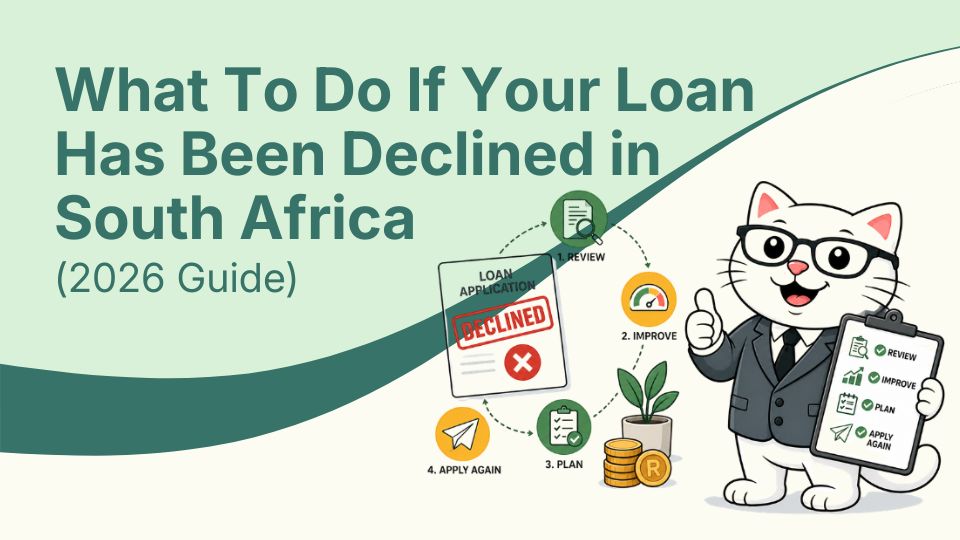
What To Do If Your Loan Has Been Declined in South Africa (2026 Guide)
Last Updated: July 2026
Getting told your loan application has been declined can be frustrating, especially if you were relying on the money for an important expense.
The good news is that a declined application doesn’t necessarily mean you won’t qualify for credit in the future. In many cases, understanding why your loan was declined can help you improve your chances the next time you apply.
South African lenders must follow the National Credit Act (NCA), which means they are required to assess whether a loan is affordable before approving it. They will also consider factors such as your credit history, income, existing debt, employment stability and banking behaviour.
Every lender has its own approval criteria, so being declined by one lender does not necessarily mean you will be declined by another.
In this guide, we’ll explain the most common reasons loans are declined in South Africa, what you should do next and practical steps you can take to improve your chances of approval.
At a Glance
✓ Loan declines are common and don’t always mean you have bad credit.
✓ Affordability is one of the biggest reasons lenders reject applications.
✓ Applying to multiple lenders in a short period may reduce your chances of approval.
✓ Understanding your credit profile can help you identify issues before applying again.
✓ Improving your financial profile may increase your chances of approval.
12 Common Reasons Your Loan Was Declined
The most common reasons a loan application is declined in South Africa include affordability concerns, poor credit history, existing debt, missing documentation, lender-specific criteria and difficulties verifying your income. Understanding the reason for the decline is the first step towards improving your chances of approval.
| Reason | Can You Fix It? | Should You Apply Again Immediately? |
|---|---|---|
| Low affordability | ✅ Yes | ❌ Improve finances first |
| Poor credit score | ✅ Usually | ⏳ Wait and improve your score |
| Too much existing debt | ✅ Yes | ⏳ Reduce debt first |
| Missing documents | ✅ Yes | ✅ Once corrected |
| Incorrect information | ✅ Yes | ✅ Once corrected |
| Debt review | ⚠️ Usually no | ❌ Seek professional advice |
| Income couldn’t be verified | ✅ Yes | ✅ After providing proof |
| Multiple recent applications | ✅ Yes | ⏳ Wait a few weeks |

So you’ve been turned down for a personal loan. Why?
One of the things that makes rejection difficult is that you aren’t always informed why the lender denied your loan.
There are several possible reasons for rejection, and while it may appear to be concerning, there is nothing to be concerned about in many cases. First, we’ll go over some of the most common reasons for personal loan rejection in this section.
Your Credit Score May Be Too Low
Your credit score is a simple “grade” based on your track record of repaying loans, credit cards, and other forms of borrowing on time.
Most lenders analyse your credit history when considering whether or not to give you money. They prefer people who can manage and return their debts without late payments, defaults, judgments or other negative listings on your credit profile.
Many lenders will reject applicants with low credit scores. However, you may still be eligible for a loan elsewhere (don’t reapply straight away – more on that later).
Alternatively, work on boosting your credit score to increase your chances of getting credit in the future. If your credit history is preventing you from qualifying for traditional finance, you may also want to explore our guide to bad credit loans in South Africa, which explains the options available to borrowers with less-than-perfect credit.
If you don’t have “good” or “excellent” credit, you may learn more about your alternatives in our guide to building your credit score.
You may not meet the lender’s requirements
A good credit score is unlikely to be the sole factor lenders consider. While many lenders will grant credit to those over 18, some will have a larger limit. In that situation, you can either wait or switch providers.
Different Lenders Have Different Lending Criteria
Every lender has its own lending policy and risk appetite. Some specialise in borrowers with strong credit histories, while others are willing to consider applicants with less-than-perfect credit. This means being declined by one lender doesn’t necessarily mean you’ll be declined by another.
As a result, even the “best” borrowers will be turned down from time to time.
Affordability
A lender needs to know that a borrower can afford to repay a loan. On the one hand, it can look at the borrower’s credit history, but even the greatest intentions won’t help if the repayments are too large.
As a result, responsible lenders will only offer you loans they believe you can readily return.
If you’re worried about affordability (for example, a low income), the most straightforward approach is to ask for a smaller loan amount. Using our Loan Calculator can help you estimate repayments before submitting another application.
You Applied for More Than You Could Afford
Sometimes borrowers simply request more money than their financial circumstances support.
Lenders assess how much disposable income you have available after paying your essential monthly expenses and existing debt. If the requested loan would place too much pressure on your budget, your application may be declined.
Before applying again, consider whether a smaller loan amount would better match your affordability. If you’re unsure what lenders may realistically approve, read our guide on how much you can borrow in South Africa, which explains how income, expenses and affordability affect the amount you may qualify for.
Your Income Could Not Be Verified
Lenders need confidence that your income is stable.
If your payslips, bank statements or proof of income don’t match the information on your application, the lender may reject the application until additional verification is provided.
This is particularly common for:
- Self-employed applicants
- Freelancers
- Commission earners
- Seasonal workers
Banking Behaviour Concerns
Your banking behaviour can play an important role in a lender’s affordability assessment. Many lenders review recent bank statements to better understand how you manage your finances and whether you can comfortably afford additional credit.
They may look for:
- Returned debit orders
- Gambling transactions
- Irregular salary payments
- Frequent overdraft use
- Signs of financial distress
Improving your banking habits before applying again may strengthen your application and improve your chances of approval.
You’re Already Under Debt Review
Borrowers under debt review generally cannot take on additional credit until the debt review process has been completed or legally withdrawn.
If you’re currently under debt review, speak to your debt counsellor before considering further borrowing.
There Were Errors on Your Application
Small mistakes can delay or even prevent approval.
Always double-check:
- ID number
- Employment details
- Income
- Contact details
- Banking information
before submitting your application.
Incorrect Information on Your Credit Profile
South Africa has several major credit bureaus, including:
- TransUnion
- Experian
- XDS
- Compuscan (now part of Experian)
If you believe incorrect information is affecting your ability to borrow, you can contact the relevant credit bureau to request a review or correction of inaccurate information.
You can learn more about your rights as a credit consumer on the National Credit Regulator (NCR) website.
Your Employment History Was Too Short
Some lenders prefer applicants who have been in stable employment for several months. If you’ve recently started a new job or have frequent changes in employment, a lender may decide to wait until you have a longer employment history.
Your Documents Were Missing
Missing or incomplete documentation can delay or prevent approval. Make sure you provide all requested documents, such as identification, proof of income and bank statements, when submitting your application.
Fraud Prevention Checks
Lenders carry out identity and fraud checks to protect both borrowers and themselves. If they cannot verify your identity or notice inconsistencies in your application, they may decline the loan until further information is provided.
What not to do if denied a loan
Don’t panic if you’ve been denied a loan; think before you act. Two things to avoid:
Don’t keep applying
Remember that applying for a loan or credit card creates a mark on your credit file that other lenders can view. Lenders expect you to browse around. A flurry of applications can appear eager for credit to a lender in a short period.
Don’t Apply to Multiple Lenders at Once
After a loan decline, it may be tempting to submit applications to several lenders immediately.
However, multiple applications within a short period can create several credit enquiries, which some lenders may view as a sign that you’re experiencing financial difficulty.
Instead, take time to understand why your application was declined, improve your financial profile where possible and compare lenders carefully before applying again. Our Compare Loans guide can help you review different lenders, loan features and eligibility requirements before submitting another application.
What to do if you are denied a loan
A loan denial gives you three options:
Before applying again, it’s worth reviewing the different types of personal loans in South Africa that may better suit your financial circumstances. Different lenders offer different loan amounts, repayment terms and affordability requirements.
- Find a new lender (without firing off too many applications)
- Rebuild credit and reapply later
- Abstain from borrowing
Find a new lender
As previously stated, you must limit yourself to only a few more loan applications to protect your credit report. Before applying again, compare lenders carefully and only apply for products that match your income, affordability and borrowing needs.
Different lenders use different lending criteria. Some place greater emphasis on your credit profile, while others focus more heavily on affordability, income stability and your ability to comfortably repay the loan. Comparing lenders carefully can improve your chances of finding a loan that suits your financial circumstances.
Understanding how lenders assess affordability can also help you choose the right loan. Read our guide on how much you can borrow in South Africa before applying again.
Depending on your financial circumstances, another type of loan or a smaller borrowing amount may be more appropriate than reapplying for the same product immediately.
Borrowing from friends and family, credit unions, or remortgaging if you’re a homeowner are also options.
Rebuild your credit score and reapply later
Improving your credit profile takes time, but consistent financial habits can make a real difference. Paying your accounts on time, reducing existing debt, keeping your credit utilisation low and managing your finances responsibly may improve your creditworthiness over time.
You can learn practical ways to strengthen your credit profile in our guide to improving your credit score in South Africa.
What credit score is required for a personal loan?
It’s possible to get by without borrowing money at all. Maybe you have savings, or the purchase wasn’t necessary. You may also be able to buy it outright by delaying it for a few months.
Does a rejection of a loan affect your credit score?
Strangely, no. An unsuccessful credit application won’t influence your credit score because of the credit file records that you applied, not whether it was successful.
So don’t take this as a reason to keep applying for credit even if lenders have declined you.
How to Improve Your Chances Next Time
Although every lender has different approval criteria, there are practical steps you can take to strengthen future applications.
These include:
- Improving your credit score
- Reducing existing debt
- Paying accounts on time
- Applying for a realistic loan amount
- Avoiding multiple applications
- Keeping your bank account well managed
- If you believe incorrect information is affecting your ability to borrow, you can contact the relevant credit bureau to request that inaccurate information be reviewed or corrected.
- Comparing lenders rather than applying everywhere
Small improvements over time can significantly improve your chances of approval.
What Should You Do After a Loan Is Declined?
- Find out why your application was declined.
- Avoid submitting multiple applications immediately.
- Improve your affordability where possible.
- Reduce existing debt.
- Strengthen your credit profile.
- Compare lenders before applying again.
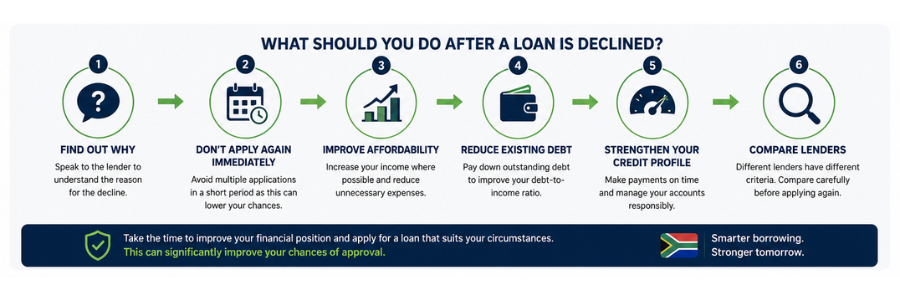
Once you’ve identified why your application was declined and taken steps to improve your financial position, comparing lenders carefully can help you find a loan that better matches your circumstances.

Can You Avoid Having Your Next Loan Declined?
Although no lender can guarantee approval, there are practical steps you can take before submitting another application.
These include:
- Checking that your application information is accurate
- Applying for a realistic loan amount
- Making repayments on time
- Reducing existing debt where possible
- Avoiding multiple loan applications within a short period
- Keeping your bank statements well managed
- Comparing lenders before applying
Preparing your application carefully can significantly improve your chances of approval while helping you avoid unnecessary credit enquiries.
Frequently Asked Questions
Why was my loan application declined?
A loan application can be declined for several reasons, including affordability concerns, a low credit score, high existing debt, insufficient income, missing documentation or lender-specific eligibility criteria. In South Africa, lenders must also comply with the National Credit Act (NCA), which requires them to ensure that a loan is affordable before approving it.
Does a declined loan application affect my credit score?
A declined application itself does not usually lower your credit score. However, the credit enquiry made during your application may appear on your credit report. Submitting multiple loan applications within a short period can make some lenders view you as a higher-risk borrower, so it’s generally better to understand why your application was declined before applying again.
How long should I wait before applying for another loan?
There is no legal waiting period, but it’s usually better to address the reason your application was declined before submitting another one. For example, you may need to reduce existing debt, improve your credit score, correct errors on your credit report or provide additional proof of income. Applying again immediately without making any changes may lead to another decline.
Can I get approved by another lender after being declined?
Yes. Every lender has its own lending criteria and risk policies. Being declined by one lender does not automatically mean every other lender will reject your application. Comparing lenders carefully and applying only when you meet their requirements can improve your chances of approval.
Can I get a loan if I have bad credit?
Possibly. Many South African lenders consider applications from borrowers with less-than-perfect credit histories. Approval usually depends on your overall affordability, current income, employment stability and ability to repay the loan rather than your credit score alone.
Can I find out why my loan was declined?
In some cases, yes. While lenders are not always required to provide a detailed explanation, they will usually tell you which credit bureau they used during the assessment. Speaking to the lender and contacting the relevant credit bureau, where appropriate, may help you identify the reason for the decline and what you can improve before applying again.
Key Takeaways
- Loan applications can be declined for many reasons, including affordability, existing debt, poor credit history and missing information.
- A declined application does not automatically mean you’ll be declined by every lender.
- Avoid submitting multiple loan applications in a short period.
- Improving your affordability and credit profile can increase your chances of approval.
- Comparing lenders carefully before applying may help you find a loan better suited to your financial circumstances.
Conclusion
Having your loan application declined can be disappointing, but it doesn’t mean you’ll never qualify for credit.
In many cases, lenders decline applications because of affordability concerns, existing debt, missing information or lender-specific lending criteria rather than simply because of a poor credit score.
Before applying again, take time to understand what may have affected your application, improve your financial position where possible and compare lenders carefully.
Applying for a realistic loan amount, reducing existing debt and strengthening your overall financial profile can significantly improve your chances of approval over time.
If you’re ready to explore your options, visit our Compare Loans page to review trusted South African lenders and find loan products that suit your income, affordability and financial goals.

The FatCat Loans Editorial Team delivers clear, accurate, and unbiased guidance on loans, credit, and personal finance in South Africa, in compliance with the National Credit Act. Our writers follow strict editorial standards to ensure every article is trustworthy, well-researched, and easy to understand, helping readers make confident financial decisions.