How Much Can I Borrow in South Africa? Salary, Affordability & Loan Guide (2026)
July 03, 2026
How Much Can I Borrow in South Africa? Salary, Affordability & Loan Guide (2026)
Last Updated: July 2026
If you’re wondering how much you can borrow in South Africa, the answer depends on far more than your monthly salary.
Every registered lender must assess whether you can comfortably afford a loan before approving your application. This affordability assessment is required under South Africa’s National Credit Act (NCA) and helps protect borrowers from taking on debt they cannot reasonably repay.
Your income is important, but lenders will also consider your monthly expenses, existing debt, credit history, employment stability and overall financial position before deciding how much they are willing to lend.
Whether you’re applying for a personal loan, online loan, instant loan or debt consolidation loan, understanding how affordability works can improve your chances of approval and help you borrow responsibly.
If you’re ready to compare lenders, you can also explore our Compare Loans page, where you can review multiple borrowing options available in South Africa.
At a Glance
✓ There is no fixed maximum loan amount in South Africa
✓ Lenders assess affordability, not just your salary
✓ Existing debt and monthly expenses reduce borrowing power
✓ A stronger credit profile may improve your chances of approval
✓ Bank statements and employment history are part of the assessment
✓ Comparing lenders can help you find a loan that suits your budget
Quick Answer
In South Africa, the amount you can borrow depends on your affordability rather than your salary alone. Lenders assess your income, monthly expenses, existing debt, credit history and employment before deciding how much they are willing to lend.
How much can I borrow in South Africa?
There is no fixed borrowing limit.
Most South African lenders calculate your loan amount based on:
- Your monthly income
- Your monthly expenses
- Existing debt repayments
- Credit profile
- Employment stability
- Disposable income
- Affordability requirements under the National Credit Act
Someone earning R12,000 per month could qualify for a different loan amount than another person earning exactly the same salary if their expenses or existing debt differ significantly.
For this reason, affordability matters far more than salary alone.
How Do South African Lenders Decide How Much You Can Borrow?
Every responsible lender follows a similar process before approving credit.
Rather than asking only “How much do you earn?”, lenders ask:
Can you comfortably repay this loan every month without causing financial hardship?
To answer that question, they build an affordability profile using several pieces of information.
These include:
- Monthly income
- Existing loans
- Credit cards
- Store accounts
- Household expenses
- Insurance
- Child maintenance
- Transport costs
- Bank statements
- Credit bureau information
The stronger your overall financial profile, the more you may be able to borrow.
1. Your Monthly Income
Income is usually the starting point.
Most lenders will ask for proof of income such as:
- Payslips
- Bank statements
- Employment confirmation
- Tax information (for self-employed borrowers)
Higher income generally increases your borrowing capacity, provided your expenses remain manageable.
However, income alone does not guarantee approval.
A person earning R40,000 per month with substantial debt may qualify for less than someone earning R20,000 who has very few financial commitments.
2. Your Monthly Expenses
Your expenses directly affect affordability.
Typical expenses include:
- Rent or bond repayments
- Electricity and water
- Food
- Fuel
- Medical aid
- School fees
- Insurance
- Childcare
- Internet
- Cell phone contracts
Lenders subtract these expenses from your income to determine how much disposable income remains available for loan repayments.
3. Existing Debt
One of the biggest factors affecting borrowing power is your existing debt.
Lenders review obligations such as:
- Personal loans
- Vehicle finance
- Home loans
- Credit cards
- Retail accounts
- Buy-now-pay-later agreements
- Microloans
If a large portion of your salary already goes towards debt repayments, lenders may reduce the amount they are willing to lend or decline the application altogether.
If you’re already managing several debts, our guide to Debt Consolidation Loans in South Africa explains how combining debts may simplify repayments for some borrowers.
4. Your Credit History
Your credit history helps lenders understand how you’ve managed credit in the past.
They typically look at:
- Payment history
- Defaults
- Judgments
- Collections
- Previous loan performance
- Current balances
- Credit enquiries
A strong credit profile may improve your chances of approval and could result in better interest rates.
If you’re unsure where you stand, read our guide on How to Get Your Free Credit Report in South Africa before applying.
5. Employment Stability
Steady employment usually provides lenders with greater confidence.
Factors they may consider include:
- Permanent employment
- Length of employment
- Consistent salary payments
- Employer stability
Self-employed borrowers can still qualify for loans but are often asked to provide additional documentation to verify income.
6. Bank Statements
Bank statements tell lenders much more than your salary.
They may review:
- Salary deposits
- Debit orders
- Returned debit orders
- Gambling transactions
- Cash flow
- Regular expenses
- Existing loan repayments
Responsible account management can strengthen your application.
Salary Examples: How Much Could You Borrow?
The table below provides illustrative examples only.
Actual approvals depend on affordability assessments, credit history, lender policies and interest rates. The South African Prime Rate plays an important role in how many lenders price loans, although your individual rate will also depend on your credit profile and affordability. Learn more in our guide to the South Africa Prime Rate.
The interest rate you qualify for may also affect the amount a lender is willing to approve, as higher borrowing costs increase your monthly repayments.
| Monthly Net Income | Example Loan Range* |
|---|---|
| R8,000 | R5,000 – R20,000 |
| R10,000 | R8,000 – R35,000 |
| R15,000 | R15,000 – R75,000 |
| R20,000 | R20,000 – R120,000 |
| R30,000 | R40,000 – R200,000 |
| R40,000+ | R80,000 – R350,000+ |
*Illustrative examples only. Loan approval depends on affordability and lender criteria.
Notice that these are broad ranges rather than guarantees. Two borrowers earning the same salary may qualify for very different loan amounts depending on their financial circumstances.

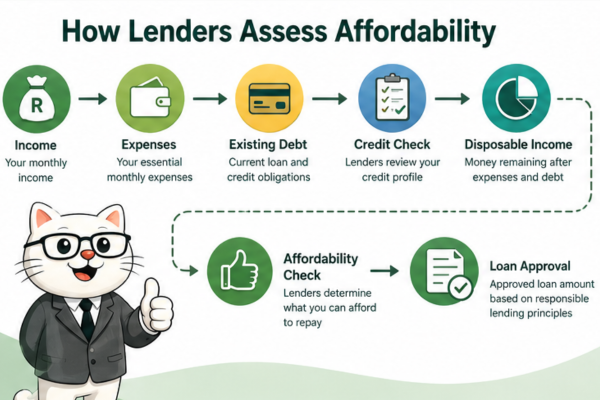
What Is an Affordability Assessment?
An affordability assessment is a legal requirement under the National Credit Act.
Before approving credit, lenders must make reasonable enquiries into your financial position to determine whether you can repay the loan.
This process generally considers:
- Income
- Existing financial obligations
- Necessary living expenses
- Credit bureau information
The purpose is to reduce the risk of reckless lending and protect consumers from taking on unaffordable debt.
You can learn more about responsible lending requirements on the National Credit Regulator (NCR) website.
How Disposable Income Affects Your Loan Amount
Disposable income is the money remaining after paying your essential monthly expenses and existing debt.
For example:
| Description | Amount |
|---|---|
| Monthly Salary | R20,000 |
| Existing Debt | R4,000 |
| Household Expenses | R8,500 |
| Insurance | R1,200 |
| Transport | R2,000 |
| Disposable Income | R4,300 |
This remaining disposable income helps determine how much you can comfortably repay each month.
A higher disposable income generally increases your borrowing capacity.

Does a Better Credit Score Mean You Can Borrow More?
In many cases, yes.
While there is no single credit score that guarantees approval, a stronger credit profile often gives lenders greater confidence that you will repay your loan on time. This can improve your chances of qualifying for a larger loan amount or receiving a lower interest rate.
A higher credit score may help you:
- Qualify for larger loan amounts
- Receive more competitive interest rates
- Access longer repayment terms
- Improve your chances of approval
- Gain access to more lender options
However, your credit score is only one part of the assessment. A borrower with an excellent credit score but very high monthly expenses may still qualify for less than someone with a fair score and a strong affordability profile.
If you’d like to improve your credit profile before applying, read our guides on Improve Your Credit Score in South Africa and How to Build Credit in South Africa.
Can You Borrow More With Bad Credit?
Yes, but it may be more difficult.
Many South African lenders consider applications from borrowers with less-than-perfect credit histories. However, they usually place greater emphasis on affordability and may offer:
- Lower loan amounts
- Shorter repayment terms
- Higher interest rates within legal limits
- Additional affordability checks
If you have missed payments in the past, don’t assume you’ll automatically be declined. Every lender has its own credit policy, and many consider factors such as your current income, recent payment history and ability to afford the repayments.
If you have a poor credit history, our Bad Credit Loans South Africa guide explains what lenders typically look for and how you can improve your chances of approval.
Can You Borrow More With a Joint Application?
Some lenders allow two applicants to apply together, although this is more common for home loans than unsecured personal loans.
A joint application combines the financial circumstances of both applicants.
Potential advantages include:
- Higher combined household income
- Greater affordability
- Larger potential borrowing amount
- Shared responsibility for repayments
However, both applicants will normally undergo affordability and credit assessments.
Remember that both borrowers become legally responsible for repaying the loan.
What Can Reduce the Amount You Can Borrow?
Many people focus only on their salary, but lenders also look closely at financial commitments.
The following factors can reduce your borrowing capacity.
| Factor | Why It Matters | Can You Improve It? |
|---|---|---|
| Monthly Income | Determines how much you can afford to repay | Increase or stabilise your income |
| Existing Debt | Reduces disposable income | Pay down balances where possible |
| Credit Score | Reflects your borrowing history | Make payments on time and reduce missed payments |
| Employment | Indicates income stability | Maintain consistent employment |
| Monthly Expenses | Affect affordability calculations | Reduce unnecessary spending |
| Bank Statements | Verify your financial habits | Avoid unpaid debit orders and manage your account responsibly |
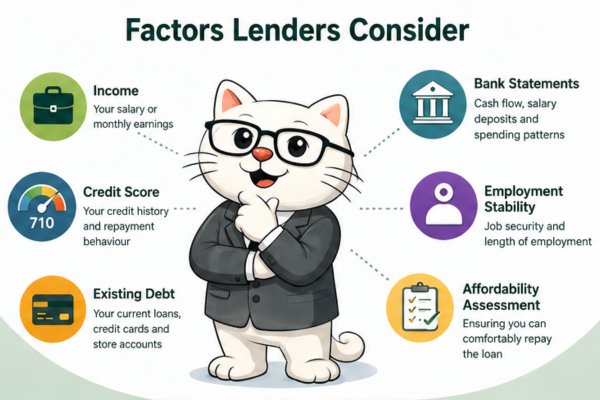
The key factors that influence your borrowing power are summarised below before we look at each one in more detail.
Existing Loan Repayments
If you’re already repaying several loans, a lender may determine that taking on additional debt would place too much pressure on your monthly budget.
Reducing outstanding debt before applying can improve affordability.
High Credit Card Balances
Large revolving credit balances may reduce the amount you qualify for.
Even if you pay your card regularly, a high utilisation rate can affect your overall financial profile.
Multiple Recent Loan Applications
Applying to several lenders within a short period may create multiple credit enquiries.
While shopping around isn’t necessarily a problem, excessive applications in a short timeframe may cause some lenders to view your application more cautiously.
Where possible, compare lenders carefully before submitting multiple applications.
Irregular Income
If your income varies significantly each month, lenders may ask for additional documentation to confirm your average earnings.
This commonly affects:
- Commission earners
- Freelancers
- Contractors
- Seasonal workers
- Self-employed individuals
Unstable Employment
Changing jobs frequently or having very little employment history may reduce the amount a lender is willing to approve.
Long-term, stable employment often provides additional confidence.
High Living Expenses
Large monthly expenses leave less disposable income available for loan repayments.
Examples include:
- High rent
- Expensive vehicle finance
- School fees
- Medical expenses
- Child maintenance
- Insurance premiums
Reducing unnecessary expenses before applying may improve affordability.
| Factor | Why It Matters | Can You Improve It? |
|---|---|---|
| Income | Determines repayment ability | Increase or stabilise income |
| Existing Debt | Reduces affordability | Pay down balances |
| Credit Score | Indicates repayment history | Make payments on time |
| Employment | Shows income stability | Maintain consistent employment |
| Monthly Expenses | Affect disposable income | Reduce unnecessary spending |
| Bank Statements | Verify affordability | Avoid unpaid debit orders |
How Much Could Your Monthly Repayment Be?
The loan amount is only part of the picture.
It’s equally important to understand how much your monthly repayments could be.
The examples below are illustrative only and assume a fixed repayment over the loan term. Actual repayments will vary depending on the lender’s interest rate, fees and repayment period.
| Loan Amount | 24 Months | 36 Months | 60 Months |
|---|---|---|---|
| R20,000 | Approximately R1,050/month | Approximately R760/month | Approximately R530/month |
| R50,000 | Approximately R2,620/month | Approximately R1,900/month | Approximately R1,320/month |
| R100,000 | Approximately R5,240/month | Approximately R3,800/month | Approximately R2,640/month |
These examples demonstrate an important point:
A longer repayment term usually reduces your monthly instalment but increases the total amount of interest paid over the life of the loan.
Before accepting any loan offer, consider both the monthly repayment and the total repayment amount.
You can also estimate repayments using our Loan Calculator before applying.
How to Increase the Amount You Can Borrow
If you’re planning to apply for a loan in the near future, there are several practical steps that may strengthen your affordability profile.
Pay Down Existing Debt
Reducing outstanding balances can increase your disposable income.
Paying off smaller loans or reducing credit card balances before applying may improve affordability calculations.
Improve Your Credit Score
Making payments on time remains one of the most effective ways to strengthen your credit profile.
Other helpful habits include:
- Paying accounts before the due date
- Keeping credit card balances low
- Avoiding missed payments
- Correcting errors on your credit report
Avoid Applying for Multiple Loans
Submitting numerous applications within a short period may not improve your chances of approval.
Instead, research lenders carefully and apply only for loans that suit your financial circumstances.
Keep Your Bank Account Healthy
Many lenders review recent bank statements.
Healthy banking habits include:
- Consistent salary deposits
- No unpaid debit orders
- Stable spending patterns
- Positive account management
Borrow Only What You Need
Borrowing a realistic amount often increases your likelihood of approval.
Requesting significantly more than your affordability supports may result in a declined application or a lower counter-offer from the lender.
Common Mistakes Borrowers Make
Many loan applications are delayed or declined because of avoidable mistakes.
Here are some of the most common.
Applying for Too Much
It’s tempting to request the maximum amount possible, but applying for more than your finances support may reduce your approval chances.
Forgetting About Monthly Expenses
Some borrowers underestimate their regular living costs.
Lenders perform their own affordability assessment and may identify expenses that weren’t included in your estimate.
Ignoring Existing Debt
Every loan repayment affects affordability.
Before applying, calculate how much of your income already goes towards existing debt.
Providing Incorrect Information
Always ensure that your income, expenses and employment information are accurate.
Providing incorrect information can delay processing or result in your application being declined.
Not Comparing Lenders
Different lenders have different affordability criteria.
Comparing multiple lenders may help you find a loan better suited to your financial circumstances rather than accepting the first offer available.
Should You Apply for the Maximum Loan Amount?
Not always.
Although you may qualify for a larger loan, borrowing only what you genuinely need can reduce:
- Monthly repayments
- Total interest paid
- Financial pressure
- Risk of future repayment difficulties
Before accepting any offer, ask yourself:
- Do I really need this amount?
- Can I comfortably afford the repayments?
- Do I have room in my budget if interest rates or living costs increase?
- Would a smaller loan meet my needs?
Responsible borrowing isn’t about qualifying for the biggest loan—it’s about choosing an amount that fits comfortably within your budget and long-term financial goals.
Frequently Asked Questions
How much can I borrow if I earn R10,000 per month?
There is no guaranteed loan amount based solely on your salary. Lenders consider your income alongside your monthly expenses, existing debt, credit history and affordability assessment. Someone earning R10,000 per month with few financial commitments may qualify for more than someone earning the same salary but already repaying several loans.
Can I get a loan if I have bad credit?
Possibly. Many South African lenders consider applications from borrowers with less-than-perfect credit histories. Approval depends on factors such as your current income, affordability, employment stability and recent repayment behaviour. A poor credit score does not automatically mean your application will be declined.
Does overtime or commission count as income?
Often, yes.
Many lenders will consider overtime, commission, bonuses or other income if it is regular and can be verified through payslips or bank statements. Requirements vary between lenders.
Can I get a loan without a payslip?
Some lenders may consider alternative proof of income, particularly for self-employed individuals or freelancers. Bank statements, tax returns or business financial records may be accepted depending on the lender’s requirements.
Will paying off debt help me qualify for a larger loan?
In many cases, yes.
Reducing existing debt can increase your disposable income, which may improve your affordability assessment and increase the amount a lender is willing to offer.
Is there a maximum personal loan amount in South Africa?
There is no single legal maximum for unsecured personal loans. The amount you can borrow depends on your affordability, income, credit profile and the lender’s own lending policies. Some lenders offer relatively small short-term loans, while others may approve substantially larger amounts for qualifying borrowers.
Final Thoughts
Knowing how much you can borrow in South Africa starts with understanding how lenders assess affordability—not simply how much you earn each month.
While salary is important, lenders also look at your monthly expenses, existing debt, employment stability, banking history and credit profile before deciding whether to approve your application and how much they are willing to lend.
The good news is that many of these factors are within your control. Paying your accounts on time, reducing existing debt, keeping your credit report healthy and borrowing responsibly can all improve your chances of approval over time.
Before applying, take a few minutes to review your finances honestly and compare lenders carefully. Applying for a loan you can comfortably afford is one of the best ways to protect your financial future.
If you’re ready to explore your options, compare reputable South African lenders and choose a loan that suits your needs rather than simply applying for the largest amount available.
Ready to Compare Loan Options?
Whether you’re looking for a personal loan, online loan, instant loan or finance for unexpected expenses, comparing lenders can help you find an option that matches your budget and financial circumstances.
Compare trusted South African lenders and discover loan options that match your income, affordability and financial goals.
Related Articles
These guides may also help you make informed borrowing decisions:
- Online Personal Loans South Africa
- Instant Loans South Africa
- Bad Credit Loans South Africa
- Loan Calculator
- Improve Credit Score South Africa
- How to Build Credit South Africa
- What To Do If Your Loan Has Been Declined
- Compare Loans
Sources
To ensure this guide is accurate and up to date, we recommend consulting the following authoritative sources:
- National Credit Regulator (NCR)
- National Credit Act, 2005 (Act No. 34 of 2005)
- National Treasury South Africa
- South African Reserve Bank (SARB)

The FatCat Loans Editorial Team delivers clear, accurate, and unbiased guidance on loans, credit, and personal finance in South Africa, in compliance with the National Credit Act. Our writers follow strict editorial standards to ensure every article is trustworthy, well-researched, and easy to understand, helping readers make confident financial decisions.