What Happens If You Miss a Loan Payment in South Africa?
October 06, 2026
What to Expect After Missing a Loan Payment
Last Updated: October 2026
Missing a loan repayment can happen more easily than you might think. Your salary may arrive late, an unexpected expense could leave your account short, or you may simply forget the payment date.
If you’ve missed a loan payment in South Africa, don’t ignore it.
Depending on your credit agreement and how long the payment remains outstanding, you could face additional charges, your payment history may be affected and the credit provider may eventually begin formal debt-enforcement procedures.
If you’ve already missed a payment, contact your credit provider as soon as possible. Ask what amount is outstanding and what you need to do to bring the account up to date.
This guide explains what may happen after a missed loan payment in South Africa, including your rights under the National Credit Act (NCA).
What Happens When You Miss a Loan Payment in South Africa?
The consequences of missing a payment aren’t necessarily immediate.
What happens will depend on your credit agreement, the type of credit you have, the credit provider and how long the account remains in arrears.
You may experience some or all of the following:
- Your payment becomes overdue
- The credit provider may contact you about the missed payment
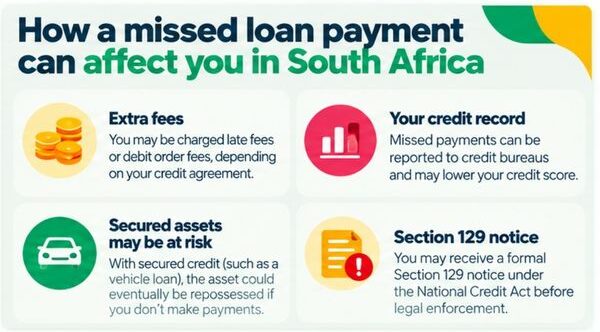
- Additional charges may apply where permitted
- Your payment history may be reported to a credit bureau
- Continued non-payment may lead to debt collection
- You may receive a formal Section 129 notice
- Legal enforcement may eventually follow if the matter isn’t resolved
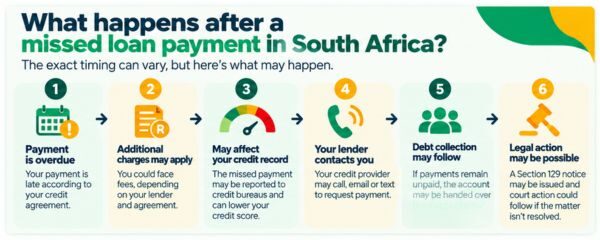
One missed payment doesn’t mean all of these things will happen. However, acting quickly can prevent a relatively small problem from becoming more difficult to manage.
1. Your Payment Becomes Overdue
Your credit agreement sets out when your repayments are due.
If you don’t make the required payment on time, your account may fall into arrears.
Your credit provider may contact you to tell you that payment is outstanding and ask you to bring the account up to date.
If the payment was missed accidentally and you have enough money available, contact the credit provider and find out exactly how much you need to pay.
Don’t automatically make a second payment without checking whether the original debit order or payment was actually unsuccessful.
2. Additional Charges May Apply
A missed payment can sometimes result in additional costs.
For example, if a debit order is unsuccessful because there isn’t enough money in your bank account, charges may apply depending on your bank, credit agreement and circumstances.
Your credit agreement should explain the costs that may apply if you don’t make payments as agreed.
Don’t assume every lender charges the same fees.
If you’ve missed a payment, ask your credit provider for an up-to-date statement or settlement of the amount currently overdue so you know what needs to be paid.
3. Missing Payments Can Affect Your Credit Record
Your repayment history is important when you use credit.
Credit providers may submit information about your accounts and payment behaviour to registered credit bureaus.
If you repeatedly pay late or fail to make payments, this may negatively affect your credit profile.
That can matter the next time you apply for credit because credit providers assess your credit history alongside other information when deciding whether credit is affordable and appropriate.
However, don’t assume that being a few days late automatically produces a particular change to your credit score.
Credit reporting and scoring are more complicated than that, and the effect will depend on the information recorded in your credit profile.
If you’re concerned about your credit history, you can obtain your credit report and check that the information recorded about you is correct.
If you’re concerned about your credit profile, our guide explains how to improve your credit score and build healthier credit habits over time.
What Happens If You Keep Missing Loan Payments?
Repeatedly missing payments is more serious than a single accidental late payment.
If your account remains in arrears, your credit provider may continue trying to recover the outstanding amount and may eventually begin formal debt-enforcement procedures.
South African consumers have protections under the National Credit Act 34 of 2005, but those protections don’t mean unpaid debt can simply be ignored.
Your Credit Provider May Contact You
Your credit provider may contact you about the overdue account and ask you to make payment.
Don’t ignore these communications.
If you can’t afford to bring the account fully up to date, tell the credit provider that you’re experiencing financial difficulty and ask whether any repayment arrangement is available.
Any arrangement should be confirmed in writing so that you understand the amount, dates and conditions involved.
The Account May Be Handed Over for Collection
If the account remains unpaid, collection activity may follow.
This doesn’t mean a collection agency can simply demand anything it wants.
Credit providers and debt collectors must operate within South African law, and there are procedures governing credit agreements and debt enforcement.
If you’re contacted about an outstanding debt, confirm who is contacting you, which account the debt relates to and how the amount being claimed has been calculated.
Keep copies of correspondence and proof of any payments you make.
What Is a Section 129 Notice?
A Section 129 notice is particularly important if you’re behind with payments on a credit agreement covered by the National Credit Act.
Section 129 of the NCA provides a process that applies before a credit provider takes certain steps to enforce a credit agreement through the courts.
The notice draws your attention to the fact that you’re in default and to options that may be available to resolve the problem.
Receiving a Section 129 notice shouldn’t be ignored.
It is a sign that your arrears have reached a more serious stage.
If you receive one, read it carefully and consider getting appropriate advice if you’re unsure what to do.
Does a Section 129 Notice Mean You’re Being Sued?
Not necessarily.
Receiving a Section 129 notice isn’t the same as receiving a court judgment.
It forms part of the process that may take place before court enforcement of a credit agreement.
The National Credit Act places requirements on credit providers before they can approach a court to enforce certain credit agreements.
This gives consumers an important opportunity to deal with the default before matters progress further.
However, ignoring the notice doesn’t make the debt disappear.
If the matter isn’t resolved, the credit provider may eventually be able to take further enforcement action in accordance with the NCA and other applicable law.
Can a Lender Repossess Your Car or Other Property?
The answer depends partly on the type of credit agreement.
With an unsecured personal loan, you haven’t pledged a particular asset as security for the loan.
Secured credit is different.
For example, vehicle finance may involve rights relating to the financed vehicle if you default.
A credit provider can’t simply ignore the legal process required by the National Credit Act and other applicable law.
Repossession and enforcement are therefore very different from simply missing a single payment.
If you’re struggling to make payments on secured credit, contact the credit provider early rather than waiting for the arrears to grow.
Can a Credit Provider Take Legal Action?
Potentially, yes.
If you remain in default and the problem isn’t resolved, a credit provider may eventually pursue legal enforcement.
The National Credit Act sets out procedures that must be followed before certain credit agreements can be enforced through the courts.
For example, Section 129 deals with notifying a consumer of the default and drawing attention to ways the matter might be resolved.
If you receive a Section 129 notice, summons or other formal legal document, don’t ignore it.
Consider obtaining independent legal advice if you don’t understand the document or your options.
What Should You Do If You’ve Missed a Loan Payment?
The best approach is to deal with the problem quickly.
1. Check whether the payment actually failed
Look at your bank account and loan account to confirm what happened.
2. Check your credit agreement
Review the payment date, repayment amount and terms relating to missed payments.
3. Contact your credit provider
Explain what has happened and ask how much is required to bring the account up to date.
4. Pay the overdue amount if you can afford to
Confirm the correct amount first, particularly if additional charges have been added.
5. Explain if you’re experiencing financial difficulty
If you can’t afford the full amount, ask whether the credit provider has an alternative repayment arrangement available.
6. Keep records
Save emails, letters, statements and payment confirmations.
What If You Know You’re Going to Miss Your Next Payment?
Don’t wait for the payment to fail.
Contact your credit provider before the due date and explain the situation.
There is no guarantee that your repayment terms will be changed, but contacting the provider early allows you to find out whether any assistance or alternative arrangement is available.
If a new arrangement is offered, make sure you understand:
- The new monthly payment
- How long you’ll be repaying the debt
- Whether additional interest or fees will apply
- The total amount you’ll repay
A smaller monthly payment isn’t automatically cheaper if it extends your repayment period significantly.
What If You Can No Longer Afford Your Debts?
If the problem isn’t limited to one missed payment and you’re struggling to meet several debt repayments, simply borrowing more money may make your situation worse.
If you’re managing several debts but can still afford repayments, you can also learn how debt consolidation loans work. Consolidating debt isn’t suitable for everyone, and any new credit remains subject to affordability assessment.
South Africa’s National Credit Act provides a formal debt review process for consumers who are over-indebted.
Debt review is handled by registered debt counsellors.
It isn’t something you should enter without understanding the consequences, and you should make sure any debt counsellor you use is registered with the National Credit Regulator (NCR).
The NCR maintains a register where consumers can check registered debt counsellors.
Will One Missed Loan Payment Ruin Your Credit Score?
Not necessarily.
There isn’t a universal number of points that every South African credit score will fall after one missed payment.
Your credit profile contains information about how you manage credit, and different credit bureaus and credit providers may use information differently when assessing risk.
What matters is that a pattern of late or missed repayments can negatively affect your credit profile.
If you’ve missed one payment, concentrate on resolving the arrears and making future payments on time rather than trying to predict an exact number of credit-score points.

Can You Get Another Loan After Missing a Payment?
A previous missed payment doesn’t automatically mean you’ll never qualify for another loan.
When you apply for credit, a credit provider must assess whether the new credit is affordable. Your income, expenses, existing financial obligations and credit history may all be relevant.
However, taking another loan purely to cover repayments on existing debt can create a cycle that’s difficult to escape.
Before applying again, work out whether you can genuinely afford another repayment alongside your existing commitments.
If you do need to consider borrowing, FatCat Loans allows you to compare personal loan options from participating South African credit providers.
Your Rights Under the National Credit Act
The National Credit Act regulates consumer credit in South Africa and provides protections for borrowers as well as rules for credit providers.
Among other things, the Act regulates credit information, responsible lending, debt counselling and the procedures involved in enforcing credit agreements.
Importantly, these protections don’t cancel a valid debt.
If you’ve fallen behind with repayments, your rights and your repayment obligations exist alongside each other.
Understanding both can help you make better decisions when dealing with an overdue account.
Frequently Asked Questions
What happens if I miss one loan payment in South Africa?
Your payment may become overdue and additional charges may apply. Your credit provider may also contact you about the arrears. If the account remains unpaid, the consequences can become more serious.
Will one missed loan payment affect my credit score?
It may affect your credit profile, particularly if the missed payment is reported to a credit bureau. The exact effect on a credit score isn’t the same for every borrower.
What is a Section 129 notice?
A Section 129 notice is part of the debt-enforcement process under the National Credit Act. It informs a consumer about a default and draws attention to options that may be available before further enforcement action.
Can a lender take legal action if I don’t pay my loan?
Potentially. If a credit agreement remains in default, a credit provider may eventually pursue legal enforcement after complying with the applicable requirements of the National Credit Act and other relevant law.
What should I do if I can’t make my loan payment?
Contact your credit provider as soon as possible. Explain your situation and ask what options may be available. If you’re struggling with several debts, consider speaking to an NCR-registered debt counsellor about your circumstances.
Can I apply for another loan after missing a payment?
You can apply, but approval isn’t guaranteed. Credit providers must assess affordability and may consider your credit history and existing financial obligations. Avoid taking additional credit if the new repayment would make your financial situation worse.
Considering a new loan? Compare your options carefully and make sure the repayments are affordable alongside your existing financial commitments.

Final Thoughts
Missing a loan payment in South Africa doesn’t mean you’re immediately facing legal action or repossession.
But it isn’t something to ignore.
Start by checking whether the payment actually failed, read your credit agreement and contact your credit provider.
If you can afford to bring the account up to date, ask the provider to confirm the amount you need to pay.
If you’re experiencing longer-term financial difficulty, ask about your options before the arrears continue to grow. Consumers struggling with multiple debts can also investigate formal debt review through an NCR-registered debt counsellor.
Most importantly, take formal notices seriously. A Section 129 notice, summons or other legal document requires attention.
Sources
- South African Government – National Credit Act 34 of 2005
- Department of Justice – National Credit Act 34 of 2005
- National Credit Regulator
- National Credit Regulator – Register of Registrants
Disclaimer: This article provides general information only and isn’t financial or legal advice. The consequences of missing a payment depend on your credit agreement and circumstances. If you’re experiencing financial difficulty, contact your credit provider or seek appropriate professional advice.

The FatCat Loans Editorial Team delivers clear, accurate, and unbiased guidance on loans, credit, and personal finance in South Africa, in compliance with the National Credit Act. Our writers follow strict editorial standards to ensure every article is trustworthy, well-researched, and easy to understand, helping readers make confident financial decisions.