Unifi Loans Review South Africa (2026): Fees & Requirements
March 02, 2026
Unifi Loans
Last Updated: September 2026
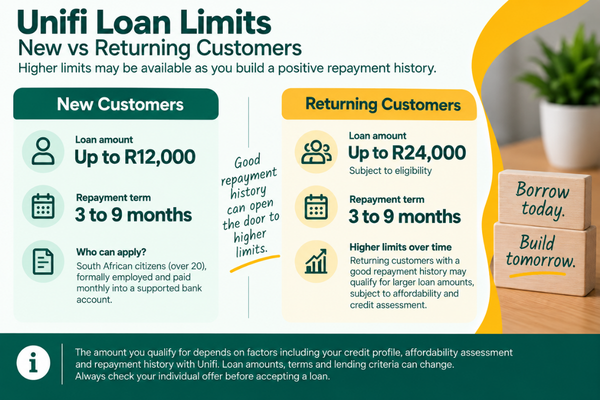
Unifi Credit is a South African online credit provider offering short-term loans with repayment terms of 3 to 9 months. New customers can currently apply for up to R12,000, while returning customers may qualify for up to R24,000.
This Unifi loans review covers loan amounts, repayment terms, fees, requirements, payout times, contact details and what to check before accepting an offer.
Unifi currently offers new customers loans of up to R12,000, with repayment terms from 3 to 9 months. Returning customers may qualify for higher limits of up to R24,000.
You can also explore other providers in the FatCat Loans lender network before choosing a loan.
Unifi Loans at a Glance
| New customer loan amount | Up to R12,000 |
| Returning customer limit | Up to R24,000, subject to eligibility |
| Repayment term | 3 to 9 months |
| Application | Online |
| Credit and affordability assessment | Yes |
| Minimum age | Over 20 |
| Employment | Formally employed and paid monthly |
| NCR registration | NCRCP4849 |
The amount you qualify for depends on factors including affordability and your credit profile. Returning customers with a good repayment history may qualify for higher limits over time.
Is Unifi Legitimate and Registered in South Africa?
Yes. Unifi Credit (Pty) Ltd is a registered South African credit provider under the National Credit Act. Its current credit provider registration number is NCRCP4849.
Unifi’s current company information lists:
- Company: Unifi Credit (Pty) Ltd
- NCR registration: NCRCP4849
- Company registration: 2010/019713/07
You can independently verify registered credit providers through the National Credit Regulator.
How Unifi Loans Work (Step-by-Step)
- Apply online and choose a loan amount and term.
- Verify income and banking (Unifi describes a “Superfast” option for automatic bank statement sharing, or manual uploads).
- Get a decision and, if approved, receive funds into the bank account where your salary is paid.
- Repay by instalments via debit order (and/or other payment options Unifi supports).
Unifi Loan Amounts and Repayment Terms
New Unifi customers can currently apply for loans of up to R12,000. Unifi states that returning customers may qualify for loans of up to R24,000, depending on factors such as affordability and credit history.
Repayment terms currently range from 3 to 9 months. Your approved amount, repayment term and monthly instalment will be shown before you accept the loan.
Who Can Apply for a Unifi Loan?
Unifi currently states that applicants must:
- Be over 20 years old
- Be a permanent South African citizen
- Be formally employed
- Earn a monthly salary
- Have their salary paid into a supported bank account
Unifi currently supports ABSA, Standard Bank, FNB, Capitec, Nedbank, African Bank and TymeBank.
How Much Does a Unifi Loan Cost? (Fees + APR Explained)
Unifi’s website provides a transparent example that includes fees and APR — which is exactly what borrowers should look at.
Table 1: Unifi example pricing (as published)
| Example Item | Published Example | What It Means |
|---|---|---|
| Loan amount | R8,000 | Your principal (amount borrowed) |
| Term | 6 months | Monthly instalments over the term |
| Monthly repayment | R1,730 | What leaves your account each month |
| Total repayment | R10,344 | Total you repay (principal + costs) |
| Initiation fee | R995 | Upfront fee added to total cost |
| Monthly fee | R69 | Monthly service/administration fee |
| Interest (monthly) | 3% | Interest rate shown as monthly interest |
| APR | 95.9% (min) to 121.1% (max) | The “all-in” annualised cost including fees |
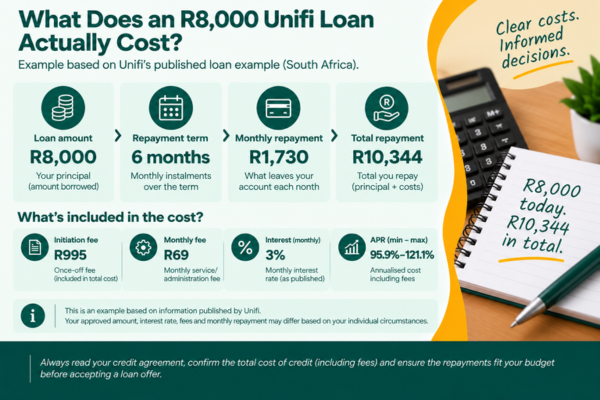
Key takeaway: When loans are short-term and fee-heavy, the APR can look very high even if the rand cost is “manageable” month-to-month. The safest way to compare is to focus on total repayment and whether the instalments fit your budget.
How Fast Does Unifi Pay Out?
Unifi states payouts can happen within hours if you use its automated bank statement sharing (“Superfast”), and up to 24 hours if you upload documents manually.
If speed is your top priority, you can also compare same-day loan options to understand how payout timing can differ by lender and bank processing windows.
My Unifi Login: How to Access Your Account
Existing customers can access their account through My Unifi on the official Unifi website.
Through My Unifi, customers can check information such as their application status and account balance, upload required information and access account details.
Always access My Unifi through the official Unifi South Africa website rather than through links received from unknown sources.
Unifi Contact Details
| Customer service | 021 110 0600 |
| [email protected] | |
| Website | unifi.credit/za/ |
Contact details checked against Unifi’s official website in September 2026. Contact information can change, so confirm the latest details directly with Unifi.
Unifi Repayments and DebiCheck
Unifi uses DebiCheck to authorise repayments. If a loan application is not approved, Unifi states that the DebiCheck mandate will be cancelled.
Unifi also explains that debit timing may change when a salary date falls on a public holiday or Monday. Borrowers should check the repayment dates shown in their loan agreement and contact Unifi if their salary timing changes.
If you are struggling to make a payment, contact Unifi as early as possible rather than ignoring a scheduled repayment.
Can I Get a Unifi Loan If I’m Blacklisted?
Unifi’s current FAQ states that people who are blacklisted can still apply. However, this does not guarantee approval. Unifi assesses factors including affordability and credit information before deciding whether to offer a loan and how much an applicant may qualify for.
Unifi also states that it does not currently assist customers who are under debt review or insolvent.
If poor credit is limiting your options, you can also read about bad credit loan options in South Africa.
Unifi Loan Scams and Fraud Warning
Loan scams can involve people pretending to represent legitimate lenders. Unifi states that it does not charge upfront fees. If someone claiming to represent Unifi asks you to pay a fee before your loan is released, treat this as a warning sign.
To help protect yourself:
- Do not pay upfront fees: Unifi states that it does not charge upfront fees before providing a loan.
- Use the official website: Apply or access My Unifi through the official Unifi website rather than links received from unknown sources.
- Verify contact details: Unifi’s current customer-service number is 021 110 0600 and its customer-service email is [email protected].
- Check NCR registration: Unifi Credit (Pty) Ltd is listed by Unifi as registered credit provider NCRCP4849. You can independently verify credit providers through the National Credit Regulator.
- Be cautious with banking information: Do not send personal documents or banking information to unverified numbers, email addresses or social-media accounts.
If you suspect someone is impersonating Unifi or asking you to pay an upfront fee, contact Unifi directly on 021 110 0600 before sending money or personal information.
Final Thoughts
Unifi Credit offers short-term online loans to qualifying South African borrowers, with new customers currently able to apply for up to R12,000 and repayment terms from 3 to 9 months.
Before accepting an offer, check the monthly instalment, interest, fees, repayment dates and total amount repayable shown in your individual agreement. Approval, loan amounts and terms depend on Unifi’s affordability and credit assessment.
If you want to consider alternatives, FatCat Loans can help you compare loan options from multiple South African lenders before you apply.

Frequently Asked Questions About Unifi Loans
How much can I borrow from Unifi?
New Unifi customers can currently apply for loans of up to R12,000. Unifi states that returning customers may qualify for higher limits of up to R24,000. The amount you qualify for depends on factors including your credit profile and affordability assessment.
How long do I have to repay a Unifi loan?
Unifi currently offers repayment terms ranging from 3 to 9 months. Your individual loan agreement will show your repayment term, monthly instalment and total amount repayable before you accept the loan.
What are the requirements for a Unifi loan?
Unifi currently states that applicants must be over 20 years old, be a permanent South African citizen, be formally employed and earn a monthly salary paid into a supported bank account. Supported banks currently include ABSA, Standard Bank, FNB, Capitec, Nedbank, African Bank and TymeBank.
How do I log in to My Unifi?
Existing customers can access their account through My Unifi on the official Unifi website. My Unifi can be used to check your application status and account balance, upload information and access account details such as statements and settlement quotes.
What are the Unifi contact details?
You can contact Unifi South Africa on 021 110 0600 or email [email protected]. Always confirm contact details through the official Unifi website before sharing personal or banking information.
How fast does Unifi pay out?
Unifi states that customers using its Superfast automatic bank-statement sharing option may receive approved funds within a few hours. If documents are uploaded or emailed manually, the process can take up to 24 hours. Actual timing can still depend on the application and banking process.
Can I apply for a Unifi loan if I’m blacklisted?
Yes. Unifi’s current FAQ states that people who are blacklisted can still apply. This does not guarantee approval, as the amount offered depends on factors including affordability and credit information. Unifi also states that it does not currently assist customers who are under debt review or insolvent.
Is Unifi registered with the NCR?
Yes. Unifi Credit (Pty) Ltd lists its National Credit Regulator registration as NCRCP4849. Its company registration number is 2010/019713/07. Borrowers can independently check credit-provider registrations through the National Credit Regulator.
Sources & Verification
We checked the information in this Unifi loans review against current Unifi information and South African consumer-credit sources. Key sources include:
- Unifi South Africa Official Website – current loan amounts, repayment terms, representative loan example, fees and eligibility information.
- Unifi South Africa FAQs – application requirements, payout information, My Unifi account access, DebiCheck, blacklisted applications, debt review, repayments and fraud warnings.
- Unifi South Africa Contact Details – current customer-service telephone number, email address and office information.
- National Credit Regulator – Register of Registrants – used to independently check South African credit-provider registration information.
- National Credit Regulator – consumer-credit information and guidance about registered credit providers in South Africa.
- National Credit Act 34 of 2005 – South Africa’s legislation governing consumer credit and registered credit providers.
Loan amounts, repayment terms, fees, eligibility information, contact details and other product information were checked in September 2026. Credit products and lending criteria can change. Always check your individual quotation and Unifi’s official website before accepting a credit agreement.

The FatCat Loans Editorial Team delivers clear, accurate, and unbiased guidance on loans, credit, and personal finance in South Africa, in compliance with the National Credit Act. Our writers follow strict editorial standards to ensure every article is trustworthy, well-researched, and easy to understand, helping readers make confident financial decisions.