Debt Consolidation Loans South Africa (2026): Take Control
June 21, 2024
Debt Consolidation Loans in South Africa: Are They Right for You?
Last Updated: October 2026
Managing several debts at once can be difficult, particularly when credit cards, store accounts and personal loans have different repayment dates, interest rates and fees.
A debt consolidation loan may allow you to combine eligible existing debts into one new credit agreement. This can make repayments easier to manage, but it does not automatically reduce your monthly instalment or the total cost of borrowing.
This guide explains what to consider before applying for debt consolidation loans in South Africa, including potential benefits, borrowing costs, eligibility and alternatives.
To explore available products and requirements, visit our debt consolidation loans page.
What Are Debt Consolidation Loans?
A debt consolidation loan is a new credit agreement that may be used to settle several eligible existing debts.
Depending on the provider and product, these may include:
- Credit card balances
- Store accounts
- Personal loans
- Overdraft balances
- Other eligible credit agreements
Instead of making separate repayments on the debts that have been settled, you repay the new loan according to its agreed schedule.
Consolidation does not erase debt or automatically close every existing credit account. Confirm which debts will be settled and whether any accounts will remain open.
For a simpler explanation of the concept, read our guide to what debt consolidation means in South Africa.
How Do Debt Consolidation Loans Work?
Debt consolidation generally involves applying for a new loan that may be used to settle eligible existing debts.
Direct Settlement by the Credit Provider
Some providers may arrange settlement directly with existing creditors. You should still confirm which debts have been settled and whether the original accounts remain open.
Settlement by the Borrower
Other arrangements may require you to use the loan proceeds to settle specified debts yourself.
Once eligible debts have been settled, you repay the new agreement according to its terms. The interest rate, fees and repayment period determine the cost of the new loan.
For a detailed breakdown, read our guide to how debt consolidation loans work in South Africa.
What Happens to Your Existing Credit Accounts After Consolidation?
When a consolidation loan is used to settle existing debts, the outstanding balances on those accounts may be paid off. However, this does not always mean the accounts are automatically closed.
For example, if your credit card balance is settled through consolidation, the credit card account may remain open unless you arrange to close it with the provider.
Before and after consolidating, consider these practical steps:
- Confirm which debts the new loan will settle.
- Request settlement confirmation from the relevant creditors.
- Check whether any credit accounts remain open.
- Consider whether keeping access to existing credit could lead to further borrowing.
- Review your credit report to check that settled accounts are reflected accurately.
Taking on new debt after consolidation can increase your total repayment commitments and undermine the purpose of combining your existing debts.
Example: When Could Debt Consolidation Make Sense?
Imagine you have three existing debts:
- Credit card balance: R12,000
- Store account balance: R8,000
- Personal loan balance: R20,000
Your total outstanding debt is R40,000.
If a credit provider approves a R40,000 consolidation loan and all three debts are eligible for settlement, the new agreement could replace those separate repayment obligations.
However, before accepting the loan, you would need to compare:
- The interest rates and fees on your existing debts
- The interest rate and fees on the proposed consolidation loan
- Your current combined monthly repayments
- The proposed new monthly instalment
- The total amount you would repay over the new loan term
Important: A lower monthly instalment may help with short-term cash flow, but extending the repayment period can increase the total cost.
This is a hypothetical example for illustration only. Actual loan terms, eligibility and settlement arrangements vary by credit provider.
When Debt Consolidation May or May Not Be Suitable
Debt consolidation is not the right solution for everyone. Your existing repayments, financial circumstances and the terms of the proposed loan all matter.
| Your Situation | What to Consider |
|---|---|
| You have several debts with different payment dates | Consolidation may simplify your repayments if the debts are eligible. |
| You qualify for a lower interest rate | You may reduce borrowing costs, but compare fees and the total amount repayable. |
| You need a lower monthly instalment | A longer repayment term may help monthly cash flow but increase total costs. |
| You are struggling to afford essential expenses | Taking on another loan may increase financial pressure. Consider seeking debt advice. |
| You are already under debt review | Further credit is generally restricted. Speak to your registered debt counsellor. |
Potential Benefits and Risks of Debt Consolidation Loans
Potential Benefits
- Simpler repayments: Eligible debts may be combined into one repayment schedule.
- Fewer repayment dates: Managing one agreement may make budgeting easier.
- Possible changes to monthly repayments: The new loan term and interest rate may change your monthly instalment.
- A structured repayment schedule: The agreement sets out your repayment obligations.
Risks and Limitations
- Higher total borrowing costs: A longer repayment period may increase the amount of interest paid.
- Additional fees: Initiation fees, service fees and other permitted charges may apply.
- Continued borrowing: Using existing credit accounts again can increase your debt.
- No guaranteed credit improvement: Consolidation does not automatically improve your credit score.
- Approval is not guaranteed: Credit providers assess eligibility and affordability.
For information about consumer credit rights and regulated lending, visit the National Credit Regulator (NCR).
Who May Qualify for Debt Consolidation Loans in South Africa?
Eligibility depends on the credit provider, the product and your financial circumstances.
Providers may consider:
- Your income and regular living expenses
- Your existing debts and repayment commitments
- Your credit information and repayment history
- The amount you want to consolidate
- Your ability to afford the proposed repayments
Application documents may include identification, income information, bank statements and details of existing debts. Requirements vary between providers.
Important: Consumers under debt review are generally restricted from taking on additional credit. If you are under debt review, speak to your registered debt counsellor before considering another loan.
For more information about eligibility and affordability assessments, read our debt consolidation loan approval guide.
Where Can You Compare Debt Consolidation Loans?
Debt consolidation products and eligibility requirements vary between credit providers. Before applying, compare the interest rate, fees, repayment period and total amount repayable.
FatCat Loans is a loan comparison platform, not a lender. Our website helps South African consumers explore available credit options, although approval and loan terms depend on individual credit providers.
You can explore our debt consolidation loan options page for more information.
If your credit history is a concern, our bad credit loans page explains broader borrowing options. However, taking on additional credit may not be suitable if you are already struggling with repayments.
What to Consider Before Applying for Debt Consolidation Loans South Africa
Before committing to a new loan, make sure you understand your financial situation and the loan terms clearly.
1️⃣ Total Repayment Cost
A longer loan term may mean lower monthly payments but higher total interest over time. Always calculate the full cost of borrowing.
2️⃣ Commitment
After consolidating, avoid taking on new debt unnecessarily — this defeats the purpose of consolidation.
3️⃣ Fees and charges
Check for:
- Initiation fees
- Monthly service fees
- Any permitted early settlement charges on existing agreements, where applicable
4️⃣ Interest Rate Trends
Interest-rate changes may affect some credit products, particularly where variable rates apply. However, the rate offered on a consolidation loan depends on the provider, product and agreement terms.
For broader information about interest-rate developments, visit the South African Reserve Bank (SARB).
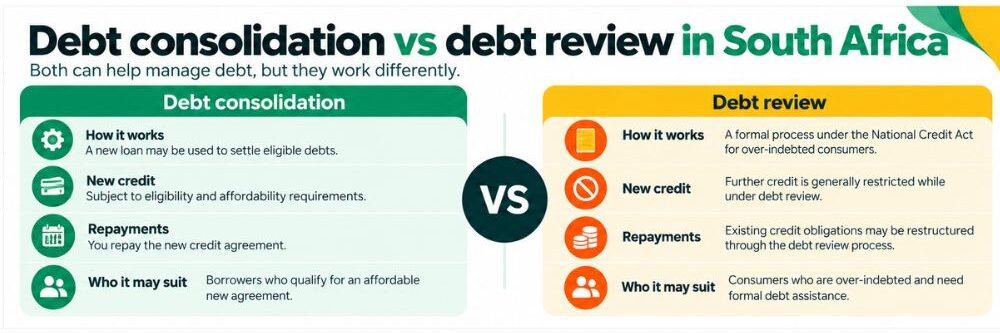
Is Debt Consolidation the Same as Debt Review?
No. Debt consolidation and debt review are different approaches to managing debt in South Africa.
| Feature | Debt Consolidation | Debt Review |
|---|---|---|
| How it works | A new loan may be used to settle eligible debts. | A formal process under the National Credit Act for over-indebted consumers. |
| New credit | Subject to eligibility and affordability requirements. | Further credit is generally restricted while under debt review. |
| Repayments | You repay the new credit agreement. | Existing credit obligations may be restructured through the debt review process. |
| Who it may suit | Borrowers who qualify for an affordable new agreement. | Consumers who are over-indebted and need formal debt assistance. |
If you are struggling to meet your existing repayments, speak to a registered debt counsellor about the options available to you.
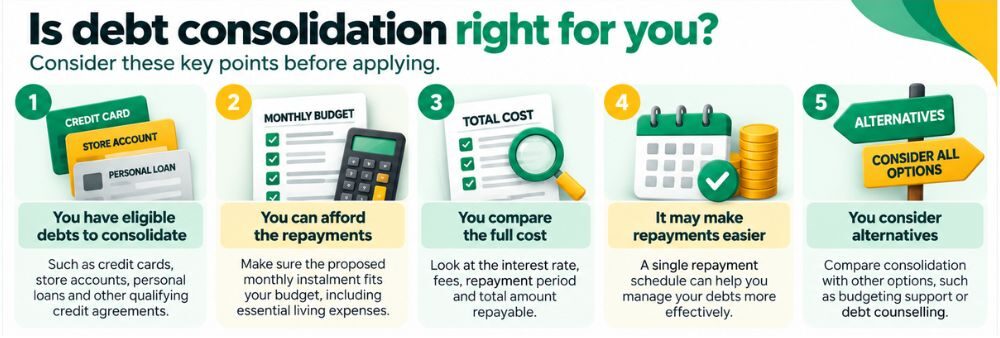
When Might Debt Consolidation Be Worth Considering?
Debt consolidation may be worth exploring if:
- You have several eligible credit agreements with different repayment dates.
- You can qualify for and afford the proposed new loan.
- You understand the interest, fees and total repayment amount.
- The new agreement would make your debts easier to manage.
- You have considered whether non-borrowing alternatives may be more appropriate.
If you are regularly missing repayments or cannot afford your essential living expenses, another loan may increase your financial pressure. Consider seeking guidance from a registered debt counsellor.
Additional Tips to Make Consolidation Successful
To get the most out of your consolidation loan:
1️⃣ Avoid New Debt
Taking on additional loans while consolidating defeats the purpose.
2️⃣ Set Up Automated Payments
Setting up a debit order or payment reminder may help you manage repayment dates. Make sure sufficient funds are available when payments are due.
3️⃣ Track Your Spending
Using budgeting tools like 22seven can keep you on track.
4️⃣ Review Your Credit Report Regularly
Make sure old debts show as paid after consolidation.
5️⃣ Create an Emergency Fund
Even small monthly savings can prevent future borrowing.

FAQs About Debt Consolidation Loans in South Africa
Will debt consolidation affect my credit score?
It may. Applying for new credit, settling existing accounts and your subsequent repayment behaviour can affect your credit profile. Consolidation does not guarantee a higher credit score.
Can I get a debt consolidation loan with bad credit?
Possibly. Eligibility depends on the provider and your financial circumstances. A poor credit history may limit your options, and approval is not guaranteed.
How long does approval take?
Approval times vary between credit providers. Additional document verification and affordability checks may be required.
Is debt consolidation the same as debt review?
No. Debt consolidation generally involves taking out a new loan to settle eligible debts. Debt review is a formal process under the National Credit Act for consumers who are over-indebted.
Will a consolidation loan save me money?
Not necessarily. Compare the interest rate, fees, repayment period and total amount repayable with your existing debts. A lower monthly instalment does not always mean lower overall costs.
Conclusion: Should You Consider a Debt Consolidation Loan?
Debt consolidation may help simplify the management of eligible existing debts, but it is not automatically the cheapest or most appropriate solution.
Before applying, compare the full cost of the proposed agreement with your current debts, consider your monthly budget and check whether the repayments would remain affordable.
To understand available products and requirements, explore our debt consolidation loan options page.
Disclosure: This article is for informational purposes only and does not constitute financial advice. FatCat Loans is a loan comparison platform, not a lender. Eligibility, approval, rates and terms vary between credit providers.

The FatCat Loans Editorial Team delivers clear, accurate, and unbiased guidance on loans, credit, and personal finance in South Africa, in compliance with the National Credit Act. Our writers follow strict editorial standards to ensure every article is trustworthy, well-researched, and easy to understand, helping readers make confident financial decisions.