WesBank Car Finance Review 2026: Rates, Requirements & How It Works
September 01, 2026
WesBank Car Finance in South Africa
Last Updated: September 2026
WesBank is one of South Africa’s best-known vehicle finance providers, offering finance for new and used vehicles through dealerships as well as qualifying private sales.
If you’re buying a car or bakkie, WesBank car finance can allow you to spread the purchase cost over an agreed repayment period rather than paying the full vehicle price upfront.
But the monthly instalment isn’t the only number that matters.
Your interest rate, deposit, repayment term, fees and any balloon payment can all affect how much the vehicle ultimately costs you.
In this WesBank car finance review, we explain how the finance works, what you may need to qualify, fixed vs linked interest rates, balloon payments, the application process and what to check before signing a vehicle finance agreement.
Important: FatCat Loans is a loan comparison service, not a lender. WesBank may not be one of the finance providers available through our service. This independent review is provided to help South African consumers research and compare their borrowing options.
WesBank Car Finance at a Glance
| Feature | WesBank Vehicle Finance |
|---|---|
| Finance type | Vehicle and asset finance |
| Cars and bakkies | Yes |
| New vehicles | Yes |
| Used vehicles | Yes |
| Dealership purchases | Yes |
| Private sales | Available subject to requirements |
| Minimum finance for cars/bakkies | R30,000 |
| Typical repayment term | 12–72 months |
| Interest | Fixed or linked, depending on deal/eligibility |
| Balloon payment | May be available |
| Deposit | Depends on deal structure |
| Credit assessment | Yes |
| Affordability assessment | Yes |
| Online application | Yes |
| Provider | WesBank, a division of FirstRand Bank Limited |
| NCR registration | NCRCP20 |
WesBank currently states that vehicle finance for cars and bakkies starts from R30,000. Its guidance describes a typical finance term as ranging from 12 to 72 months, although the terms actually available to you will depend on your application and finance agreement.
Who Is WesBank?
WesBank is a division of FirstRand Bank Limited and specialises in vehicle and asset finance in South Africa.
Rather than being a conventional unsecured personal loan that gives you cash to spend as you choose, vehicle finance is linked to the vehicle you’re purchasing.
WesBank works with affiliated dealerships around South Africa and also provides routes for financing qualifying private vehicle purchases. At dealerships, applications can be handled with the assistance of the dealership’s Finance and Insurance (F&I) consultant.
If you’re still deciding whether dedicated vehicle finance or another borrowing option may be more appropriate, see our guide to car loans in South Africa.
How Does WesBank Car Finance Work?
With vehicle finance, a finance provider funds the agreed purchase of a vehicle and you repay the debt according to the terms of your credit agreement.
Your deal can be influenced by several factors, including:
- the price of the vehicle
- your deposit
- the amount being financed
- your interest rate
- whether the rate is fixed or linked
- the repayment period
- fees
- whether you choose a balloon payment
- your credit profile and affordability
Interest is charged on the amount financed.
WesBank explains the total cost of credit broadly as the amount financed plus interest and applicable fees. This is why comparing cars purely by their advertised monthly instalment can be misleading.
A R6,000 monthly instalment over one deal structure isn’t necessarily better value than a R6,500 instalment under another.
You need to understand what you’re paying in total.
How Much Can You Finance Through WesBank?
WesBank currently states that vehicle finance for cars and bakkies starts at R30,000.
The amount you’re actually approved to finance will depend on factors such as:
- your income
- monthly living expenses
- existing debts
- credit history
- affordability
- the vehicle being purchased
- your proposed finance structure
Meeting the basic requirements doesn’t guarantee approval.
Under South Africa’s National Credit Act, credit providers must assess whether consumers can afford the credit they’re applying for. WesBank describes affordability and creditworthiness as key parts of its vehicle-finance assessment.
Don’t confuse the maximum you qualify for with what you can comfortably afford
This is particularly important with cars.
Suppose you’re approved to finance a R500,000 vehicle.
That doesn’t necessarily mean spending R500,000 is a sensible decision.
Your monthly car budget also needs to account for costs such as:
- comprehensive insurance
- fuel
- servicing
- maintenance
- tyres
- licence fees
- parking
- tolls where applicable
- unexpected repairs
WesBank itself warns buyers to consider the total cost of vehicle ownership, not merely whether they can make the monthly finance instalment.
If you’re working out what level of borrowing may fit your budget, our guide to how much you can borrow in South Africa explains some of the factors that can affect affordability.
What Interest Rate Does WesBank Charge?
There isn’t one WesBank vehicle-finance interest rate that applies to everyone.
Your rate can depend on your financial circumstances, credit profile, affordability and the structure of your finance agreement.
This means you should be careful with searches such as “What is the WesBank interest rate?”
Another person’s rate isn’t necessarily the rate you’ll receive.
Your quotation and pre-agreement statement are what matter.
Fixed vs Linked WesBank Interest Rates
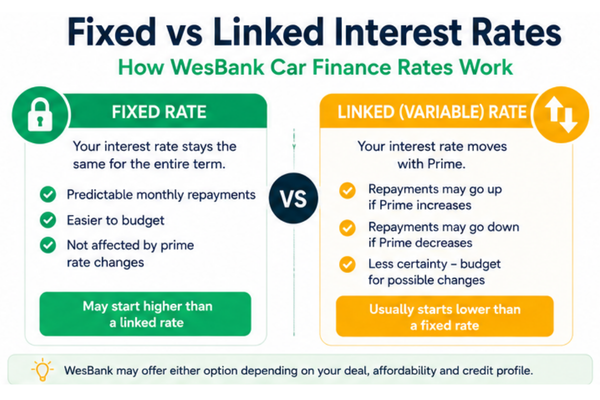
Depending on your deal structure, affordability and credit profile, WesBank says you may have access to either a fixed or linked (variable) interest rate.
Understanding the difference is important.
Fixed interest rate
With a fixed-rate agreement, your interest rate remains the same throughout the agreed finance period.
The main advantage is predictability.
If your instalment is R7,000 today, a change in South Africa’s prime lending rate won’t increase that instalment simply because interest rates have moved.
WesBank notes that a fixed rate may initially be higher than a linked rate, but it can make budgeting easier because your repayment isn’t affected by future prime-rate changes.
Linked interest rate
A linked or variable interest rate moves in relation to South Africa’s prime lending rate.
If prime increases, your interest rate and monthly repayment can increase.
If prime falls, your interest rate and repayment can decrease.
WesBank confirms that changes to prime affect instalments on linked agreements, while fixed-rate instalments aren’t affected by prime-rate movements.
Neither option is automatically better.
The question is whether you value predictable repayments or are comfortable accepting the possibility that your monthly repayment could move up or down.
How Long Can You Finance a Car Through WesBank?
WesBank’s current guidance describes typical vehicle-finance terms as ranging from 12 to 72 months.
A longer term can make the monthly instalment look much more affordable.
But there’s a trade-off.
Longer term
You may get:
- lower monthly repayments
- more room in your monthly budget
But you can also:
- pay interest for longer
- increase the total cost of finance
- remain in debt on the vehicle for longer
Shorter term
Your monthly repayment will generally be higher, but you may pay less interest overall because the debt is being repaid sooner.
WesBank’s own 2026 consumer guidance recommends looking at the total repayment over the full finance term, rather than focusing only on the monthly number.
Do You Need a Deposit for WesBank Car Finance?
A deposit is money you pay towards the vehicle upfront.
For example, if a vehicle costs R300,000 and you contribute a R50,000 deposit, the amount that needs to be financed is reduced before considering other amounts that may form part of the deal.
A larger deposit can therefore:
- reduce the amount you need to finance
- lower your monthly repayment
- reduce the amount on which interest is charged
- potentially reduce the overall cost of borrowing
Whether a deposit is required and how much you’ll need depends on your particular deal and approval.
A deposit also shouldn’t be confused with a balloon payment.
They’re almost opposites.
Deposit = money paid at the beginning.
Balloon = money deferred until the end.
That brings us to one of the most important parts of any South African vehicle-finance agreement.
What Is a Balloon Payment on WesBank Car Finance?
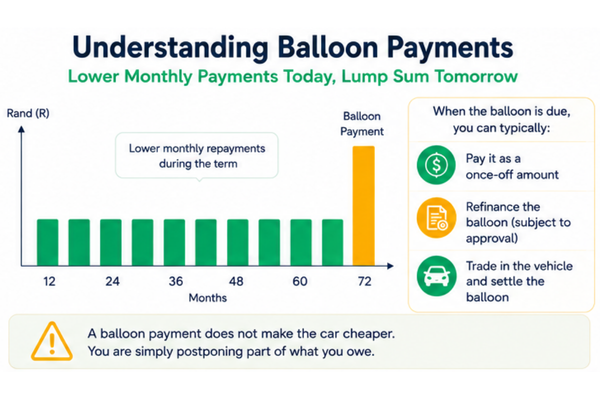
A balloon payment is a lump sum that is deferred until the end of the vehicle-finance term.
It reduces the instalments you pay during the agreement because part of what you owe is being left until the end.
For example, imagine you finance a vehicle over 72 months with a balloon.
You make your regular monthly repayments, but after payment number 72 there is still an agreed lump sum that must be dealt with.
WesBank currently identifies three potential options when a balloon becomes due:
- Pay it as a once-off amount
- Refinance the balloon, subject to a new finance application and approval
- Trade in the vehicle and use its trade-in value towards settling the balloon
Does a balloon payment make the car cheaper?
No.
This is probably the single most important thing to understand about balloon finance.
A balloon can make your monthly instalment lower, but it doesn’t make the vehicle itself cheaper.
You’re postponing part of the debt.
WesBank’s June 2026 balloon-payment guidance uses the example of a R350,000 vehicle financed over 60 months at 11.5%, comparing finance with and without a 20% balloon to demonstrate the effect on repayments and overall cost.
The attraction is obvious: lower monthly repayments.
The risk is equally important: you still need a plan for the lump sum at the end.
And if you refinance that balloon, you’re entering into another credit agreement and potentially paying further interest.
Balloon payments have become increasingly common
This isn’t a niche issue for South African car buyers.
WesBank reported that 35% of its new finance deals included a balloon payment in August 2025, up from 27% the previous month. The average balloon size was also substantial.
That makes understanding the structure especially important.
Don’t choose a balloon simply because it gets the monthly instalment down to a number that fits your budget.
Ask yourself:
“How am I going to pay the balloon when it becomes due?”
If you don’t have a realistic answer, reconsider the deal structure.

What Cars Can You Finance Through WesBank?
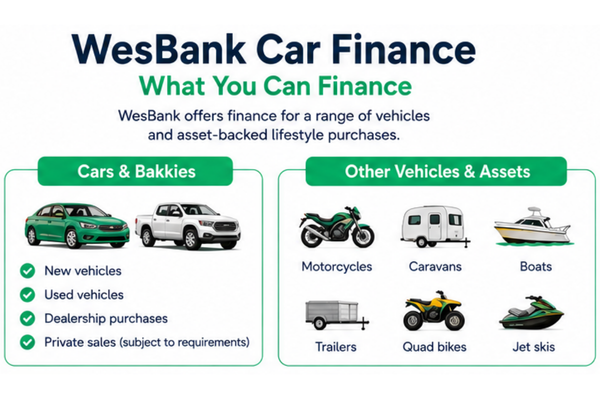
WesBank provides finance for new and used cars and bakkies, subject to its lending and vehicle criteria.
You can potentially finance a vehicle purchased through a WesBank-affiliated dealership or qualifying private seller. WesBank’s Fast Application service for cars and bakkies currently starts from a minimum finance amount of R30,000.
WesBank also offers separate specialist finance for other types of vehicles and leisure assets, including motorcycles, caravans, trailers, boats, quad bikes and jet skis.
The fact that WesBank finances used vehicles doesn’t mean every used car will automatically qualify. The vehicle and transaction still need to meet the applicable finance requirements.
Buying from a dealership
WesBank works with hundreds of affiliated dealerships around South Africa.
The dealership’s F&I consultant can submit a finance application and help structure the proposed deal. Alternatively, WesBank’s online Fast Application process allows qualifying applicants to start the process themselves and take their application reference to a dealership.
Buying a car privately
WesBank also supports qualifying private-sale vehicle finance.
This can be useful if you’ve found a vehicle directly from its owner rather than through a dealership.
However, don’t assume that financing a private purchase works exactly like financing through a dealer. Additional vehicle, seller and transaction checks may apply before the finance can be finalised.
How Quickly Can You Apply for WesBank Car Finance?
WesBank offers a Fast Application process for cars and bakkies.
According to WesBank’s Fast Application guidance, qualifying applicants can potentially obtain finance approval in under 10 minutes.
That statement needs some context.
“Approval in under 10 minutes” doesn’t mean:
- everyone will be approved
- your vehicle will be delivered in 10 minutes
- the dealership will immediately receive payment
- no documents are required
After an application progresses, documents still need to be provided and the finance agreement needs to be finalised.
If you’re buying from a dealership, the application reference can be taken to the dealer, where the proposed deal can be completed and relevant extras incorporated before the agreement is signed.
Who Can Qualify for WesBank Car Finance?
To qualify for WesBank car finance, you’ll need to meet some basic eligibility requirements.
According to WesBank’s current vehicle-finance requirements, you generally need to:
- be over 18
- be a South African citizen or foreign national with permanent residency
- have a valid driver’s licence
- earn at least R7,500 per month
- have sufficient affordability
- have a satisfactory credit record
Meeting these requirements doesn’t guarantee that WesBank will approve your application.
WesBank says affordability and creditworthiness are two of the main considerations when assessing vehicle-finance applications.
Your affordability is essentially whether your income, after necessary expenses and existing financial commitments, leaves enough room for the proposed vehicle repayment.
Your creditworthiness considers your history of managing credit and repaying debt.
That distinction matters because a relatively high salary doesn’t automatically guarantee vehicle-finance approval if you’re already heavily committed to other debts.
What Documents Do You Need for WesBank Vehicle Finance?
WesBank currently lists the following basic documents:
- a copy of your valid ID
- proof of residential address no older than three months
- three months’ bank statements
- proof of income, such as a recent payslip
WesBank notes that some FNB customers may not need to submit all of these documents.
Additional documents can be required depending on your circumstances and the transaction.
Having everything ready before you apply can make it easier to complete the process if your initial application is successful.
Does WesBank Check Your Credit Score?
Yes.
WesBank assesses your creditworthiness when you apply for vehicle finance.
However, it would be misleading to suggest that there is one publicly advertised WesBank credit score that automatically determines whether you’ll be approved.
WesBank explains creditworthiness as an assessment of how likely you are to repay what you owe based on your credit history. It considers this alongside affordability when deciding whether to grant vehicle finance.
Your credit profile can potentially affect:
- whether your application is approved
- the amount you’re able to finance
- the interest rate you’re offered
- whether a deposit is required
- the finance structure available to you
A good credit history can strengthen an application, but it still doesn’t override affordability.
If you want to understand what happens when you apply for credit, read our guide to soft vs hard credit checks in South Africa.
What if you have bad credit?
A poor credit history can make qualifying for vehicle finance more difficult.
For example, missed repayments, defaults or a history showing difficulty managing existing credit may make a lender less comfortable taking on the additional risk.
But avoid assuming that a particular score automatically means “approved” or “declined”.
WesBank doesn’t publish a universal minimum credit score for standard vehicle finance on the product information we’ve reviewed.
If your credit profile is weak, it can be sensible to check your credit report before applying so you can identify incorrect information or understand what lenders are likely to see.
And be cautious of anyone advertising “guaranteed WesBank car finance”, particularly if they claim that no credit or affordability assessment is required.
Can You Get WesBank Car Finance With Bad Credit?
Potentially, but approval isn’t guaranteed.
WesBank assesses both affordability and creditworthiness, rather than stating that everyone above or below a particular credit score will receive the same decision.
A weaker credit profile could potentially result in:
- an application being declined
- a less favourable interest rate
- a lower affordable finance amount
- different conditions being attached to an offer
This is also why repeatedly applying for vehicle finance with several providers when you already know your finances are stretched may not be the best approach.
If you’ve already been turned down for finance, our guide on what to do if your loan application is declined explains some of the steps you can take before applying again.
If the monthly payment on the vehicle is only affordable because you’re cutting essential spending or using other credit to get through the month, the car may simply be outside your current budget.
Can Self-Employed People Apply for WesBank Vehicle Finance?
Being self-employed doesn’t necessarily mean you can’t obtain vehicle finance.
However, a self-employed application can require more information because the lender needs sufficient evidence to establish your income and affordability.
WesBank’s standard requirements include proof of income and bank statements, and it states that the exact documentation required can depend on the application.
If you’re self-employed, be prepared for the lender to request financial information that helps demonstrate your income and ability to meet the proposed repayment.
Don’t assume that the standard payslip requirements for an employed applicant will necessarily be the complete document list for your application.
What Fees Does WesBank Charge for Vehicle Finance?
Interest isn’t the only cost of WesBank car finance.
WesBank currently lists two standard vehicle-finance contract fees for individuals:
| Fee | Current WesBank amount |
|---|---|
| Initiation fee | R1,207 excluding VAT |
| Monthly administration fee | R69 including VAT |
According to WesBank’s current vehicle-finance fee information, the initiation fee is charged once and can either be incorporated into the finance agreement or paid upfront.
The monthly administration fee forms part of your monthly instalments.
These costs matter because adding an initiation fee to the amount financed means you’re not simply paying the fee — it becomes part of the financed balance.
Your quotation should clearly show the costs applicable to your particular agreement.
Watch the dealership extras too
The finance provider’s charges aren’t necessarily the only additional costs you’ll encounter when buying a vehicle.
A dealership may offer extras or charge amounts associated with the transaction.
Before agreeing to them, ask:
What is this charge for?
Is it compulsory?
Am I paying it upfront or financing it?
Will interest be charged on it if it is added to the finance agreement?
WesBank’s Fast Application process specifically notes that a dealership can restructure an approved deal to include additional fees or extras you choose.
Adding R20,000 of optional extras to vehicle finance doesn’t merely increase the purchase price by R20,000 if you’re then paying interest on that amount for several years.
Do You Need Comprehensive Insurance With WesBank?
Yes.
This is a particularly important difference between vehicle finance and an unsecured personal loan.
WesBank states that comprehensive vehicle insurance is a contractual requirement for vehicles financed through it.
Allowing the financed vehicle to remain uninsured during the finance agreement can constitute a breach of the contract.
Comprehensive insurance typically protects against risks such as accident damage, theft and hijacking, subject to the policy’s terms, exclusions and excess.
You’ll therefore need to include the insurance premium when deciding whether you can afford the car.
For example, if your vehicle repayment is R7,000 per month and comprehensive insurance costs another R1,500, your real monthly vehicle commitment is already at least R8,500 before considering:
- fuel
- servicing
- maintenance
- tyres
- licence fees
- parking and tolls
That’s why “Can I afford the instalment?” isn’t quite the right question.
A better question is:
“Can I afford to own and run this car?”
What happens if the car is stolen or written off?
Comprehensive insurance can pay the insured value if a vehicle is stolen or written off, subject to the terms of the policy.
However, the insurance payout isn’t necessarily the same as the amount still owed to WesBank.
If you owe R300,000 but the insurer pays R270,000, there could be a R30,000 shortfall.
WesBank offers optional shortfall cover for this type of risk, but borrowers should compare the cost and terms of any additional insurance before buying it.
WesBank Dealership Finance vs Private-Sale Finance
One of the more useful features of WesBank is that vehicle finance isn’t restricted to cars purchased from dealerships.
It also provides a structured process for qualifying private vehicle sales.
Buying through a dealership
If you’re buying from a WesBank-affiliated dealership, there are two main routes.
You can work with the dealership’s Finance and Insurance (F&I) consultant, who submits the finance application and helps structure the proposed agreement.
Alternatively, you can start with WesBank’s online Fast Application and take your approval reference to an affiliated dealership.
The dealership then uses the reference to retrieve your application.
Before the transaction is completed:
- You agree to an Offer to Purchase.
- Any deposit and applicable dealership fees are agreed.
- Your supporting documents are sent to WesBank for verification.
- You pay the agreed deposit or dealership fees.
- You sign the finance agreement.
- The dealership prepares the vehicle for delivery.
WesBank also provides an iContract system that allows qualifying customers to review and sign their vehicle-finance contract digitally.
Buying privately
The private-sale process is different — and potentially very useful if you’ve found a good vehicle directly from an owner.
According to WesBank’s private-sale finance information, finance is currently available for qualifying vehicles being sold for R30,000 or more.
The basic process is:
1. Apply for finance
You apply to finance the vehicle you’ve found.
2. Provide the seller’s details
Once finance approval has been confirmed, WesBank contacts the seller and confirms the relevant information.
3. Vehicle checks are completed
The seller arranges the required roadworthy test and technical inspection.
WesBank says its private-sale process goes beyond the mandatory roadworthy by also requiring a technical inspection.
4. Review the results
You receive the results and decide whether you’re satisfied with them.
5. Sign the finance contract
If you’re happy to proceed, the finance agreement can be signed online.
6. Collect the vehicle
The vehicle is handed over and WesBank pays the seller the purchase price.
This added structure can remove some of the uncertainty that comes with sending a large amount of money directly to a private seller.
However, you should still inspect the vehicle carefully and understand exactly what you’re buying.
How to Apply for WesBank Car Finance
WesBank allows applicants to start the vehicle-finance process online.
Here’s how the process generally works.
Step 1: Decide what you can realistically afford
Before applying, work out a sensible vehicle budget.
Don’t start with:
“What’s the most WesBank will lend me?”
Start with:
“What monthly vehicle cost can I comfortably afford?”
Include insurance and running costs rather than looking at finance alone.
Step 2: Choose a vehicle or explore your affordability
WesBank’s Fast Application allows you to obtain an indication of affordability and, if you already have a car in mind, link that vehicle to the application.
Qualifying applicants can potentially receive finance approval through the Fast Application process in under 10 minutes.
Step 3: Complete your application
You’ll provide personal, employment and financial information so WesBank can assess your application.
The lender will consider your affordability and creditworthiness.
Step 4: Submit your documents
You’ll generally need your:
- ID
- driver’s licence
- proof of address
- recent proof of income
- three months’ bank statements
Requirements can vary depending on your circumstances.
Step 5: Review the proposed deal
If approved, don’t immediately focus on whether you can afford the monthly payment.
Check:
- vehicle purchase price
- deposit
- amount financed
- interest rate
- whether the rate is fixed or linked
- repayment term
- initiation fee
- monthly fee
- balloon payment
- optional extras
- insurance requirements
- monthly instalment
- total cost of credit
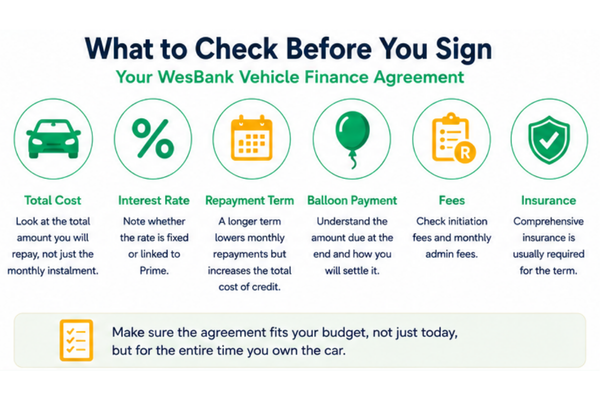
If there’s something you don’t understand, ask before signing.
Step 6: Sign the agreement
Once your documentation and vehicle transaction have been verified, the finance contract can be completed.
WesBank’s iContract system allows eligible customers to read and sign their vehicle-finance contract online.
Step 7: Take delivery
After the agreement has been finalised and the necessary dealership or private-sale requirements have been completed, you can take delivery of the vehicle.
Can You Pay WesBank Car Finance Off Early?
Yes.
If you want to repay the vehicle finance before the scheduled end of the agreement, you need to obtain a settlement quotation.
Don’t simply look at the balance displayed on your latest statement and transfer that amount.
WesBank explains that an early-settlement figure can differ from the account balance, so you should request an official settlement quote showing the amount required to settle the agreement.
According to WesBank’s early-settlement guidance, where the finance agreement is below R250,000, the settlement amount will generally consist of the outstanding capital plus daily interest
For agreements above R250,000, WesBank says the settlement amount also includes an early termination fee equal to 90 days’ interest on the remaining capital balance.
Its settlement quotations are currently valid for five business days.
This is an area where the exact agreement matters, so always obtain the current settlement quotation rather than trying to calculate the figure yourself.
When might you need a settlement quote?
Common situations include:
- selling your car before the finance term ends
- trading the vehicle in
- paying off the debt with savings or a lump sum
- refinancing elsewhere
- settling after an insurance claim
If you’re trading the car in, compare its trade-in value with the settlement amount.
For example:
Settlement amount: R280,000
Trade-in offer: R240,000
Shortfall: R40,000
That R40,000 doesn’t disappear because you’re buying another car.
Be very careful about simply rolling a shortfall from one vehicle into your next finance agreement. Doing so can leave you financing debt from a car you no longer own.
What Happens if You Miss a WesBank Car Payment?
Missing a vehicle-finance payment is more serious than simply being a few days behind on an ordinary household bill.
If you don’t make the agreed payment, the account can fall into arrears.
Your statement may then reflect the normal instalment plus the arrears amount and applicable arrear interest.
Continued missed repayments can potentially lead to:
- additional permitted costs
- collection activity
- negative credit-bureau information
- damage to your credit profile
- legal enforcement
- ultimately, loss of the financed vehicle through the appropriate legal process
If you think you’re going to struggle with a repayment, contact WesBank as early as possible rather than ignoring the account.
And avoid automatically taking out another expensive loan simply to cover the car instalment.
That can turn one affordability problem into two.
WesBank Car Finance Pros and Cons
There are some clear advantages to WesBank vehicle finance, but that doesn’t make it the best choice for every buyer.
Pros
Established vehicle-finance provider
WesBank is a division of FirstRand Bank Limited and operates as a registered credit provider.
Finance for new and used vehicles
You’re not restricted to buying a brand-new car.
Dealership and private-sale options
WesBank supports purchases through affiliated dealerships as well as qualifying private transactions.
Digital application process
The Fast Application tool provides a convenient way to start the process online.
Fixed or linked interest structures
Depending on the agreement available to you, you may be able to choose a finance structure that better suits your attitude to interest-rate movements.
Balloon-payment option
A balloon can reduce monthly repayments where appropriate — although it creates a significant final payment that needs to be planned for.
Structured private-sale process
Roadworthy and technical inspections provide additional checks when financing a private purchase.
Cons
Your advertised monthly payment isn’t the full cost of owning the car
Insurance, fuel, maintenance and other running expenses still need to fit your budget.
Comprehensive insurance is compulsory
You’ll need to maintain comprehensive cover for the financed vehicle throughout the agreement.
Personalised interest rates
You won’t necessarily know your actual rate until your application has been assessed.
Balloon payments can make deals look cheaper than they really are
A low monthly instalment can hide a substantial amount that still needs to be paid or refinanced at the end.
Fees increase the total borrowing cost
The initiation fee and monthly administration fee need to be considered alongside interest.
Approval isn’t guaranteed
Meeting the minimum income and documentation requirements doesn’t mean you’ll necessarily pass WesBank’s credit and affordability assessment.
Who Might WesBank Car Finance Suit?
WesBank may be worth considering if you:
- want to finance a new or used car
- are buying through a dealership
- have found a suitable vehicle through a private seller
- earn at least R7,500 per month
- have sufficient disposable income for the vehicle repayment
- have a reasonable credit history
- want the ability to compare fixed and linked-rate structures where available
- understand the implications of any balloon payment
- can afford comprehensive insurance as well as the finance instalment
It may be less suitable if:
- another monthly debt repayment would stretch your budget
- your credit history currently makes mainstream finance difficult to obtain
- you can’t afford comprehensive vehicle insurance
- you’re relying on a large balloon purely to make an otherwise unaffordable vehicle fit your monthly budget
- you’re already struggling to meet existing credit repayments
The key question isn’t whether you can get approved for the car.
It’s whether you can comfortably afford the finance, insurance and running costs for the entire period you plan to own it.
WesBank vs Other Car Finance Providers
WesBank isn’t the only major vehicle-finance provider in South Africa.
Depending on where you’re buying your vehicle and your financial circumstances, you may also come across providers such as MFC (a division of Nedbank), Absa Vehicle Finance and Standard Bank Vehicle and Asset Finance.
The important thing is not simply which provider approves you.
Compare the actual finance offers you receive.
| Feature | WesBank | MFC | Standard Bank |
|---|---|---|---|
| New & used vehicles | Yes | Yes | Yes |
| Dealership finance | Yes | Yes | Yes |
| Private-sale finance | Yes | Yes | Available subject to product criteria |
| Fixed/linked rates | Available depending on deal | Yes | Available |
| Balloon option | May be available | Yes | Flexible payment options available |
| Maximum advertised term | Typically up to 72 months | Up to 96 months* | Up to 84 months* |
*Terms and finance structures depend on the vehicle, applicant and provider’s criteria. A longer maximum term doesn’t mean you’ll qualify for it or that it will be the cheapest option.
MFC currently allows vehicle-finance terms from 12 months up to 96 months on certain deals, depending on factors including the vehicle’s year, make and model. It also offers fixed or linked rates and balloon structures.
Standard Bank currently advertises vehicle-finance repayment periods from 12 to 84 months, with the 84-month option requiring discussion with its Vehicle and Asset Consultant.
Don’t compare vehicle finance on the monthly instalment alone
Imagine one provider offers:
Option A: R6,800 per month
Option B: R7,300 per month
Option A might initially look better.
But it could have:
- a longer repayment period
- a larger balloon payment
- a higher interest rate
- higher total finance charges
The only sensible comparison is to look at the complete quotation.
Compare:
- interest rate
- fixed or linked rate
- deposit
- amount financed
- repayment period
- balloon payment
- fees
- monthly instalment
- total cost of credit
A lower monthly instalment does not necessarily mean cheaper car finance.
If you’re still deciding how to fund your next vehicle, you can also read our guide to car loans in South Africa.
Is WesBank Car Finance Worth Considering?
WesBank is a well-established vehicle-finance provider and offers several features that make it worth including when comparing car-finance options.
Its ability to finance both dealership and qualifying private-sale purchases is useful, while fixed or linked interest structures and optional balloon payments provide flexibility in how a deal may be structured.
Its online application process is another advantage.
However, none of these features means WesBank will automatically offer you the cheapest finance.
Your individual interest rate, deposit, repayment term, balloon, fees and total borrowing cost matter far more than the lender’s brand.
The best approach is to obtain a quotation and compare it carefully with other suitable finance options before signing.
Frequently Asked Questions About WesBank Car Finance
What is the minimum salary for WesBank car finance?
WesBank currently states that applicants generally need to earn at least R7,500 per month. Meeting the minimum income requirement doesn’t guarantee approval. WesBank will also consider your affordability and creditworthiness when assessing your application.
What is the minimum amount WesBank will finance?
WesBank currently states that finance for cars and bakkies starts from R30,000. The amount you’re approved for will depend on your financial circumstances, affordability, credit profile and the vehicle transaction.
What interest rate does WesBank charge for car finance?
WesBank doesn’t advertise one interest rate that applies to every applicant. Your rate is determined according to your application and finance agreement. Depending on the deal available to you, your interest rate may be fixed or linked to the prime lending rate.
Can I finance a second-hand car through WesBank?
Yes. WesBank finances qualifying new and used vehicles. Finance is available through participating dealerships and for qualifying private-sale transactions.
Can I buy a car privately using WesBank finance?
Yes. WesBank offers private-sale vehicle finance for qualifying transactions. Its process includes vehicle and seller checks, and the vehicle may need roadworthy and technical inspections before the transaction is completed.
Does WesBank offer balloon payments?
Yes, balloon-payment structures may be available. A balloon reduces the regular monthly instalment by leaving an agreed lump sum outstanding at the end of the finance period. It doesn’t make the vehicle cheaper, so you should understand how you’ll deal with the balloon before accepting the agreement.
Compare Car Loan Options in South Africa
WesBank is one option for financing a vehicle, but it’s worth considering what type of borrowing best suits your purchase and budget.
Before signing any credit agreement, compare:
- how much you need to borrow
- your interest rate
- fees
- repayment period
- monthly repayment
- any balloon payment
- the total amount you’ll repay
FatCat Loans provides information and comparison options to help South Africans research borrowing choices.

FatCat Loans is not a lender and doesn’t make credit decisions. Loan availability, amounts, rates and terms depend on the lender and your individual circumstances.
Final Verdict
WesBank remains a strong option to consider for South Africans looking to finance a new or used vehicle.
Its established presence in vehicle finance, dealership network, private-sale option and choice of finance structures give buyers considerable flexibility.
But don’t judge a car-finance deal by the monthly instalment alone.
A long repayment period or large balloon can make an expensive vehicle appear more affordable each month while increasing your longer-term financial commitment.
Before signing, look at the interest rate, fees, repayment period, balloon payment and total cost of credit.
Most importantly, make sure you can afford not just the car repayment, but also the insurance and ongoing cost of owning the vehicle.

The FatCat Loans Editorial Team delivers clear, accurate, and unbiased guidance on loans, credit, and personal finance in South Africa, in compliance with the National Credit Act. Our writers follow strict editorial standards to ensure every article is trustworthy, well-researched, and easy to understand, helping readers make confident financial decisions.